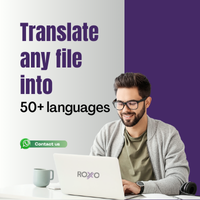

In today’s globalized world, language should never be a barrier. Whether you are a business expanding to new markets, a student applying for an international program, or simply someone who needs official documents translated, the ability to convert files into multiple languages is more important than ever. Modern technology and professional translation services make it possible to translate any file into 50+ languages with precision and reliability. But why does it matter, and how can it help you?
In this post, we will explore the importance of professional translations, the benefits of having access to more than 50 languages, the types of files that can be translated, and how it can transform your personal and professional opportunities.
Why Professional Translation Is Different from Automatic Translation
One of the most common misconceptions is that translation is simply about replacing words from one language with words from another. However, true translation is about meaning, context, and culture.
Automatic online tools can sometimes be helpful for casual conversations, but when it comes to important documents—such as contracts, diplomas, certificates, or business presentations—accuracy is non-negotiable. A small mistake in a legal or official file can have serious consequences.
Professional translation ensures:
Accuracy: Every word and term is translated correctly according to context.
Consistency: Terminology remains uniform across the entire document.
Cultural Adaptation: Local expressions, formats, and cultural nuances are respected.
Legality: Certified translations can be recognized by official institutions worldwide.
The Power of 50+ Languages
Imagine this: you write a single document, and suddenly, it is available in more than 50 languages across the world. That means your ideas, products, or qualifications can reach millions of people who would otherwise never understand your message.
Some of the most requested languages for translation include:
English: International business and academia.
Spanish: Spoken across 20+ countries.
French: Language of diplomacy and global institutions.
German: Key in science, engineering, and EU business.
Portuguese: Essential for Brazil, Portugal, and parts of Africa.
Arabic: Widely used across the Middle East and North Africa.
Mandarin Chinese: The most spoken language in the world.
Russian: Important for trade and politics.
But beyond these, having access to 50+ languages means no barrier is too big. Whether it’s translating a business contract into Japanese, a medical report into Italian, or an academic paper into Korean, you have global reach.
Types of Files You Can Translate
One of the strengths of modern translation services is flexibility. Today, it’s not just about text on a page—you can translate almost any file type. Here are some examples:
Documents (Word, PDF, Excel, PowerPoint)
Contracts, certificates, diplomas, reports.
Websites & Apps
Making your business digital presence multilingual.
Marketing Materials
Brochures, presentations, social media content.
Technical Files
Manuals, instructions, product specifications.
Birth certificates, marriage licenses, immigration papers.
With the right tools and professionals, no format is too complex to handle.
Why Certified Translations Matter for Documents
When it comes to official documents, many institutions such as universities, embassies, and government offices require certified translations. This means the translation is not just accurate, but also legally valid.
A certified translator provides a signed statement that the translation is complete and faithful to the original. This is often required for:
Immigration applications.
Visa processes.
University admissions.
International job applications.
Legal procedures.
Without certification, even a perfect translation might not be accepted. That’s why it’s essential to rely on professional, recognized translation services.


The Benefits of Professional Translation for Businesses
If you are a company, translating documents and files into multiple languages is not just a matter of convenience—it’s a competitive advantage.
-
Expand to New Markets: A product manual translated into local languages builds trust with customers.
-
Improve Customer Experience: Clients appreciate when contracts, invoices, or guides are available in their own language.
-
Boost SEO and Digital Presence: A multilingual website ranks higher in international search engines.
-
Professional Image: High-quality translations show professionalism and respect for cultural diversity.
In fact, studies show that customers are much more likely to buy products if the information is presented in their native language.
How Technology Helps (But Doesn’t Replace Humans)
Modern translation tools, such as AI-powered systems, make the process faster and more accessible. They can quickly process large amounts of text and suggest translations. However, the human touch remains essential.
Why? Because languages are full of idioms, tone, and cultural references that machines still cannot fully capture. For example:
-
The phrase “It’s raining cats and dogs” cannot be literally translated in most languages—it needs a cultural equivalent.
-
Legal terminology often varies by jurisdiction and must be carefully adapted.
The ideal solution is a combination of technology and human expertise: technology speeds up the process, while professional translators ensure quality and accuracy.
Tips for Choosing the Right Translation Service
When looking for a service to translate any file, keep these points in mind:
Check Experience: Choose providers with a proven track record in your industry.
Ask About Certification: Ensure they can provide certified translations if needed.
File Flexibility: The service should accept different formats (PDF, Word, images, etc.).
Turnaround Time: Confirm delivery times, especially for urgent documents.
Confidentiality: Sensitive information must be handled securely.
Real-Life Examples
-
Student Applications: A Brazilian student applying for a U.S. university needs his transcripts and diplomas translated into English. Only certified translations are accepted.
-
Business Expansion: A European company launching in Latin America translates its contracts, product manuals, and website into Spanish and Portuguese.
-
Immigration: A family applying for residency abroad must provide translated birth certificates, marriage licenses, and medical records.
In each case, access to reliable translation services makes the difference between success and rejection.
Conclusion: Breaking Language Barriers
We live in a world where opportunities are global—but only if we can communicate across languages.
From personal documents to corporate strategies, translation is not just about words—it’s about trust, credibility, and connection. And in a competitive, globalized world, those who speak many languages—accurately and professionally—always have the advantage.
Related topics: Certified translation services | Translate documents for immigration | Professional document translator | Birth certificate translation | Fast online translations











 Iniciar Conversa
 Faça Seu Pedido