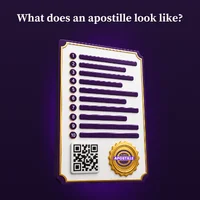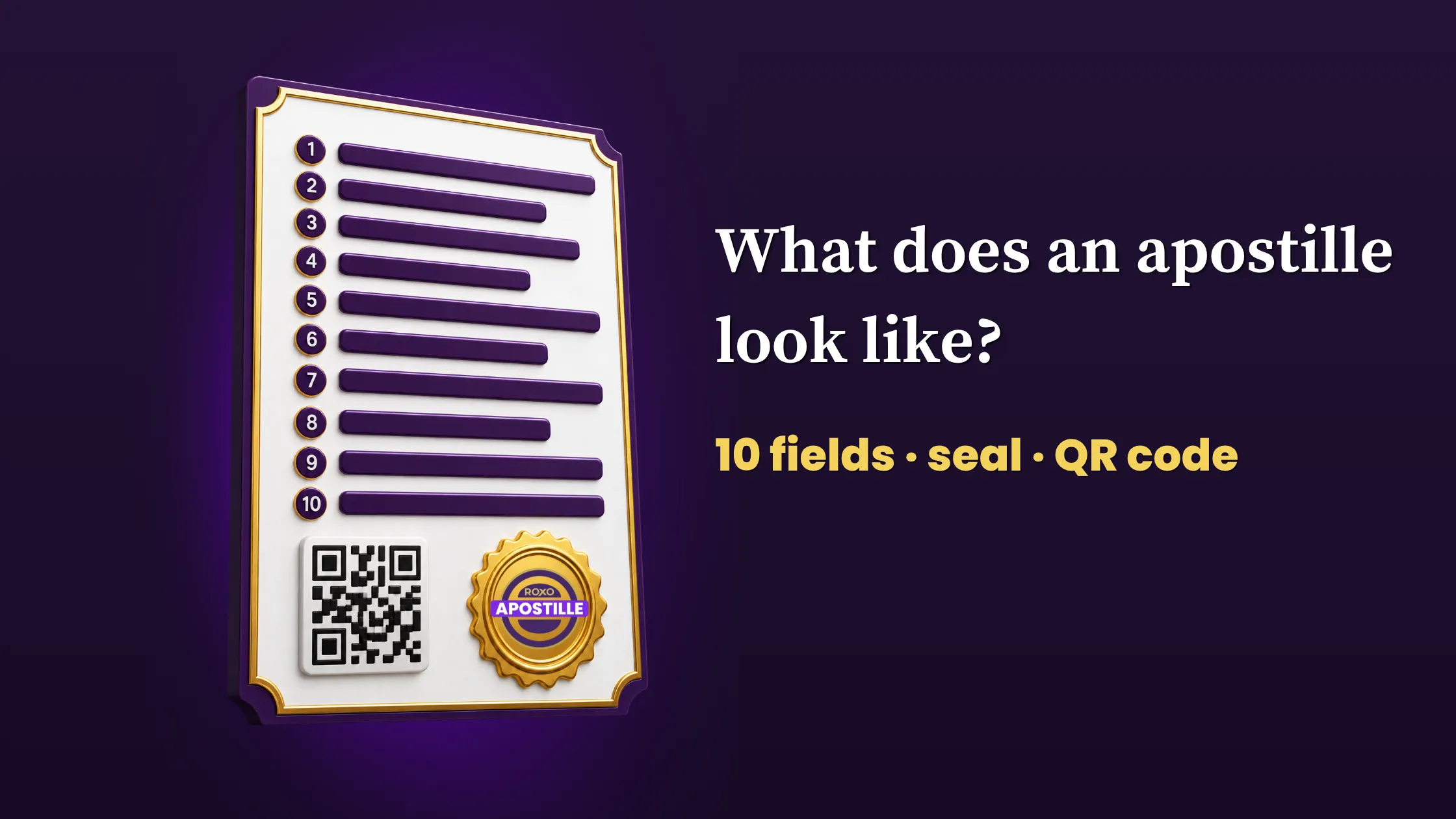
What does an apostille look like: it is a standardized certificate, created by the 1961 Hague Convention, titled "Apostille (Convention de La Haye du 5 octobre 1961)", with 10 numbered fields that identify the document, the person who signed it and the authority that certified it. In Brazil, the apostille is electronic and carries a QR code that can be checked on the CNJ website.
Knowing how to read these fields helps you check that the apostille is right before you send the document abroad.

Key takeaways
- An apostille follows a single model, the same in every Hague Convention country.
- It has 10 numbered fields: the first ones describe the document, the next ones the certification.
- The authority's seal and signature close the apostille.
- In Brazil, the apostille is electronic, with a QR code that can be checked on the CNJ website.
- One apostille covers one document.
Contents
- A single model in every country
- The 10 numbered fields
- The Brazilian apostille and the QR code
- How to check your apostille
- Frequently asked questions
A single model in every country
The 1961 Hague Convention created a standardized certificate so that any member country recognizes another country's apostille without having to decode a new format. That is why the apostille has the same title and the same numbered fields in every country, even when the language of each field changes.
The 10 numbered fields
- Country that issues the apostille
- Name of the person who signed the document
- Capacity of the signer
- Seal or stamp on the document
- Place of certification
- Date of certification
- Authority that issues the apostille
- Apostille number
- Seal or stamp of the authority
- Signature of the authority
Fields 2 to 4 describe the public document and who signed it; fields 5 to 10 describe the certification: where, when, by whom and under what number the apostille was issued.
The Brazilian apostille and the QR code
In Brazil, only notary offices authorized by the CNJ issue apostilles, since August 14, 2016, and the apostille is electronic, with a QR code that can be checked on the CNJ portal. For a born-digital Brazilian document, the original is not needed. In the United States, on the other hand, the state apostilles the paper: for a Florida document, for example, the original is needed.
How to check your apostille
| What to check | Where to look |
|---|---|
| That the apostille is from the country that issued the document | Field 1 |
| That the name and capacity match who signed the document | Fields 2 and 3 |
| That a Brazilian apostille is authentic | QR code, on the CNJ website |
| That the number and date are legible | Fields 6 and 8 |
Frequently asked questions
Does an apostille always have the same format?
Yes. The model is the one from the 1961 Hague Convention, with the same title and the same 10 numbered fields in every member country.
How do I know if a Brazilian apostille is authentic?
The Brazilian apostille is electronic and has a QR code, which can be checked on the CNJ website.
How many apostilles do I need?
One apostille covers one document. Ask the destination agency whether it wants the original or a copy.
Do I need the original to get an apostille?
For a Florida document, yes: the state apostilles the paper. For a born-digital Brazilian document, no: the apostille is electronic.
Want to apostille your document?
Now you know what an apostille looks like and what to check on it. Tell us where the document was issued and where it is going, and we handle the request.
Related topics: apostille services | certified translation | certified translation for USCIS | help center
Related article: Who issues an apostille















 Press Release
 Power of Attorney
 Driving License
 Sworn Affidavits
 User Manual
 Birth Certificate
 Brochures
 Passport
 Academic Transcripts
 Financial Statement
 Certificates
 Resume
 Medical Records
 Marriage Certificate
 Emails

 Arabic
 Chinese
 French
 German
 Italian
 Japanese
 Korean
 Portuguese
 Russian
 Spanish
 Vietnamese