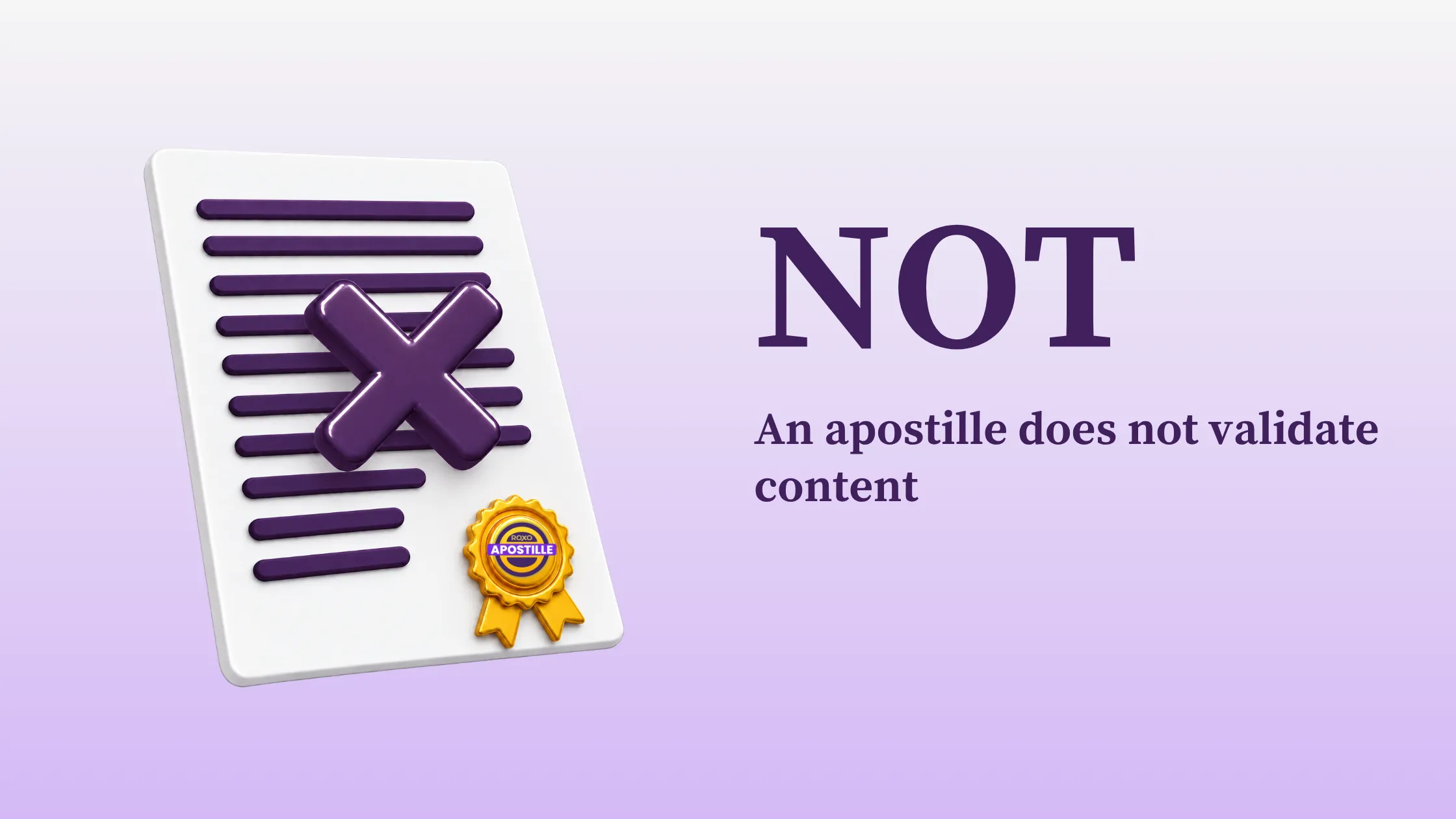
What an apostille does not do: it does not validate the content of the document, it does not translate anything, it does not work outside the Hague Convention countries and it does not make an old document new again. An apostille authenticates the origin: the signature and seal of whoever issued the document. Everything else still depends on the document itself and on whoever receives it.
Knowing these limits avoids paying for an apostille that does not solve the problem, or thinking it replaces something the destination agency still asks for.

Key takeaways
- An apostille does not validate the content: it authenticates the signature and seal, not the information.
- An apostille does not translate anything: if the destination asks for another language, the translation is separate.
- An apostille only works in Hague Convention countries; for the others, the path is consular legalization.
- An apostille does not expire, but the document under it can.
- For USCIS, an apostille is not required: what is required is a certified translation.
Contents
- It does not validate the content
- It does not translate the document
- It does not work in every country
- It does not renew the document
- USCIS does not require it
- Frequently asked questions
It does not validate the content
An apostille authenticates the signature and seal of the public official who issued the document. It does not assess whether the written information is true and it does not fix any error in the original: if a certificate has a misspelled name, the apostille does not correct it. It only confirms that the document came from who it says it came from.
It does not translate the document
An apostille does not translate anything. If the destination agency asks for the document in the local language, the translation goes into the same order as a separate step. So whether an apostilled document needs a translation depends on who receives it, not on who apostilles it.
It does not work in every country
An apostille only works in Hague Convention countries. For the others, the path is consular legalization, done by the consulate of the destination country, a longer process. We handle apostilles; we do not handle consular legalization today. Tell us the destination country and we confirm which path applies.
It does not renew the document
The apostille itself does not expire, but the document under it can. Many agencies only accept recently issued certificates, and apostilling an old certificate does not make it recent. The destination agency defines the accepted timeframe, so check its requirement before ordering. And one apostille covers one document.
USCIS does not require it
USCIS requires a certified translation, not an apostille. Apostilling a document for US immigration is a cost with no purpose. If another agency in your process asks for an apostille, then it applies.
| What an apostille does | What an apostille does not do |
|---|---|
| Authenticates the signature and seal of whoever issued the document | Does not validate content or fix errors |
| Makes the document valid in another Hague Convention country | Does not work outside the Convention (there, consular legalization) |
| Is valid indefinitely | Does not renew an old document |
| Goes with the original document | Does not translate anything |
Frequently asked questions
Does an apostille confirm that the information in the document is true?
No. It confirms the signature, the signer's capacity and the seal, and does not assess the content.
Is an apostille valid in any country?
Only in Hague Convention countries. For the others, the path is consular legalization, which we do not handle today.
Does an apostille expire?
The apostille itself does not expire, but the document under it can. Many agencies only accept recently issued certificates.
Does USCIS require an apostille?
No. USCIS requires a certified translation, not an apostille.
Want to know if your document needs an apostille?
Now you know what an apostille solves and what it does not. Tell us where the document is going, and we confirm whether it needs an apostille, a translation or both.
Related topics: apostille services | certified translation for USCIS | certified translation | help center
Related article: What does a Hague Apostille authenticate?
















 Criminal Record
  Patent Application
  Passport
  Death Certificates
  Financial Statement
  Power of Attorney
  Academic Transcripts
  Legal Contract
  Driving License
  ID Card
  Sworn Affidavits
  Medical Records
  Marriage Certificate
  Vaccination Record
  Birth Certificate
 Arabic
  Chinese
  French
  German
  Italian
  Japanese
  Korean
  Portuguese
  Russian
  Spanish
  Vietnamese