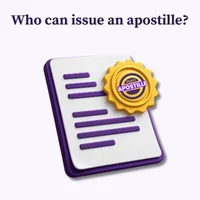
Who issues an apostille: always the authority of the issuing country
Read More
What the apostille is, which documents can be apostilled and in what order it goes with the translation.
Yes, through our sister service Roxo Apostille, which handles review, filing and logistics. The apostille itself is always issued by the authority of the country that issued the document. We do not handle federal documents (such as FBI records) or consular legalization.
An apostille is a standardized certificate, created by the 1961 Hague Convention, that authenticates the origin of a public document: the signature, position and seal of whoever issued it. It does not validate the content. It is accepted in the 120+ countries that are party to the Convention.
The authority of the country that issued the document. A Florida document goes to the Florida Department of State; a Brazilian one goes to a registry authorized by the CNJ. Roxo handles the request but is never the issuing authority.
A notarization is a Notary Public confirming the identity of whoever signed a document. An apostille is issued by a government authority and authenticates the signature and seal of a public official, so the document is accepted in another Hague Convention country. A private document is often notarized first and then apostilled.
It depends on the case. The document can be apostilled first and then translated, so the translation also covers the apostille, or translated first and apostilled afterwards. The receiving agency defines the order, so tell us the destination country and agency and we confirm before quoting.
Usually the original, and some destinations, such as France, also require the sworn translation to be apostilled. An apostille on the translation alone only proves the translator's signature and is often refused. Ask the receiving agency which it requires.
That depends on who receives it, not on who apostilles it: the apostille translates nothing. If the receiving authority wants the document in the local language, the translation goes in the same order.
One apostille covers one document. Ask the receiving authority whether it wants the original or a copy.
No. USCIS requires a certified translation, not an apostille. Apostilling a document for US immigration is an expense with no function. If another agency in your process asks for an apostille, tell us which one.
Yes. Through a partner cartório, a new digital copy of civil registry certificates can be issued from any Brazilian registry and apostilled electronically, with no need to go in person. A recent copy also meets agencies that require recently issued certificates.
Yes. Through a partner cartório, a new digital copy of birth, marriage and death certificates can be issued from any Brazilian registry, with no need to go in person, and apostilled electronically if needed. A recent copy also meets agencies that require recently issued certificates. Send us the details and you receive an itemized quote.
It depends on the document and the route. Send a scan and you receive an itemized quote: the official fee, passed on at cost, the service fee and logistics, listed separately so you can see what goes to the government.
US$ 10 per document, or US$ 20 when the document is certified by a Florida Clerk of the Court (US$ 10 for the apostille plus US$ 10 for the certificate of incumbency). It is the state's fee, not ours, and it appears on its own line in the quote. Florida Department of State figures, checked in September 2026.
The fee (emolumento) follows each state's official table, so it varies. It is a public fee, not ours, and it appears on its own line in the quote.
No. A document is apostilled only in the country that issued it: Brazilian documents in Brazil, by a cartório authorized by the CNJ, and US documents by the Secretary of State of the issuing state. Brazilian apostilles are electronic, so you do not need to travel.
Documents issued in Florida are apostilled by the Florida Department of State, in Tallahassee. We file it for you, in person or by mail.
Yes. What matters is where the document was issued, not where you live: with a Florida certificate, we serve you in Boston, Lisbon or Bogotá.
Only registries authorized by the CNJ issue apostilles, since 14 August 2016 (Decreto 8.660/2016 and Resolução CNJ 228/2016). The apostille is electronic, with a QR code that can be checked on the CNJ portal.
No. Our partner registry works electronically, so we cover all 27 Brazilian states without you leaving home.
Yes, once apostilled and translated by a sworn translator. For some purposes it also has to be registered at an RTD in Brazil, and our partner does that registration too.
Public documents: birth, marriage and death certificates, diplomas and transcripts, court decisions, company records and criminal records. Private documents, such as a power of attorney, can be apostilled after notarization. A plain photocopy cannot.
For a Florida document, yes: the state apostilles the paper. For a Brazilian digitally-born document, no: the apostille is electronic.
Yes, but almost always the registrar's signature has to be notarized first. A diploma sent without that step comes back.
Only in countries that are party to the Hague Apostille Convention. For other countries the route is consular legalization, which we do not offer today. Tell us the destination country and we confirm.
Both authenticate a document for use abroad. The apostille is a single certificate, valid among the countries of the Hague Convention. Consular legalization is the longer route for countries outside it, done through the destination country’s consulate. We handle apostilles; consular legalization is not offered today.
The apostille itself does not expire, but the document under it may. Many agencies only accept certificates issued recently. The receiving agency sets that rule, so check its requirements before ordering.
The Brazilian apostille is electronic and has a QR code, which can be checked on the CNJ website.
Usually not. US states apostille the certified copy issued by the vital records office itself. A notarized photocopy is the most common reason for refusal, so request a certified copy from the issuing state first.
Request a certified copy from the vital records office of the state where you were born, then have it apostilled by that state’s Secretary of State. Roxo Apostille can handle the filing and logistics. If it will be used abroad, we confirm with you whether the translation comes before or after the apostille.
No. FBI records are federal documents, apostilled only by the US Department of State, and we do not handle federal documents. Once the apostille is done, we can translate the record and the apostille as a certified or sworn translation.
There are two clocks: ours, for review and filing, and the issuing authority's, which we do not control. Both appear separately in your quote.
If it is digital, send the file. If it is on paper, by tracked mail to our address in Windermere, or by an arranged handover.
If the refusal comes from our mistake, we redo it at no cost. If it comes from the document, such as the wrong version or an expired one, we tell you what has to change. The check before payment exists so that this almost never happens.
Usually your Brazilian certificates apostilled in Brazil and translated into the country's language. The consulate or municipality defines the list and how recent each certificate must be. Send us their list and we build the complete order.
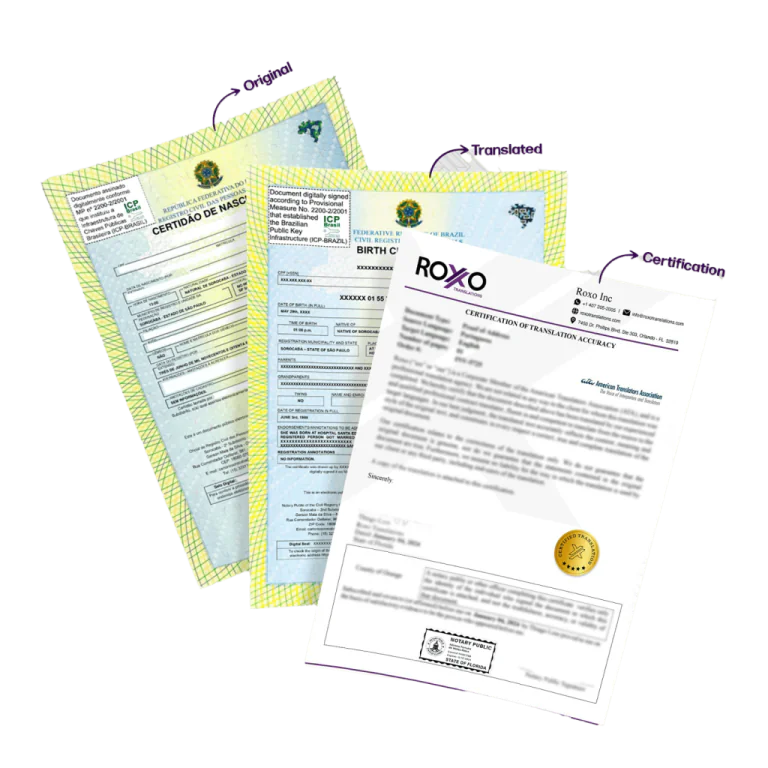
Complete certified translation solutions in the USA for immigration, legal proceedings, and official processes. Our certified translators guarantee precision, fast delivery, and full compliance with USCIS standards in every document we handle.
Certified translations accepted in the USA. Perfect for immigration, schools, and official processes. Fast delivery.
Official sworn translations accepted in Brazil (Juramentada) and abroad. Certificates, contracts, academic documents, and more.
Apostille for documents issued in Brazil or in any US state. We tell you which copy is accepted and check it before charging. Free document review.

Certified translation of documents for driver's license applications in the USA. Accepted by DMV/RMV and official agencies.

Professional audio and video transcription with high accuracy. Ideal for meetings, interviews, webinars, and corporate content.
100% online







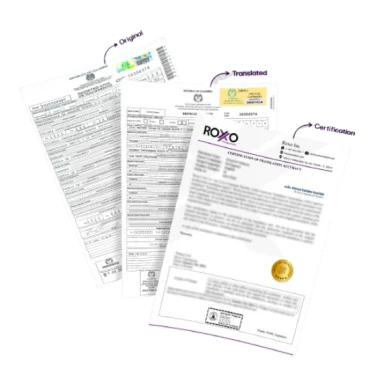
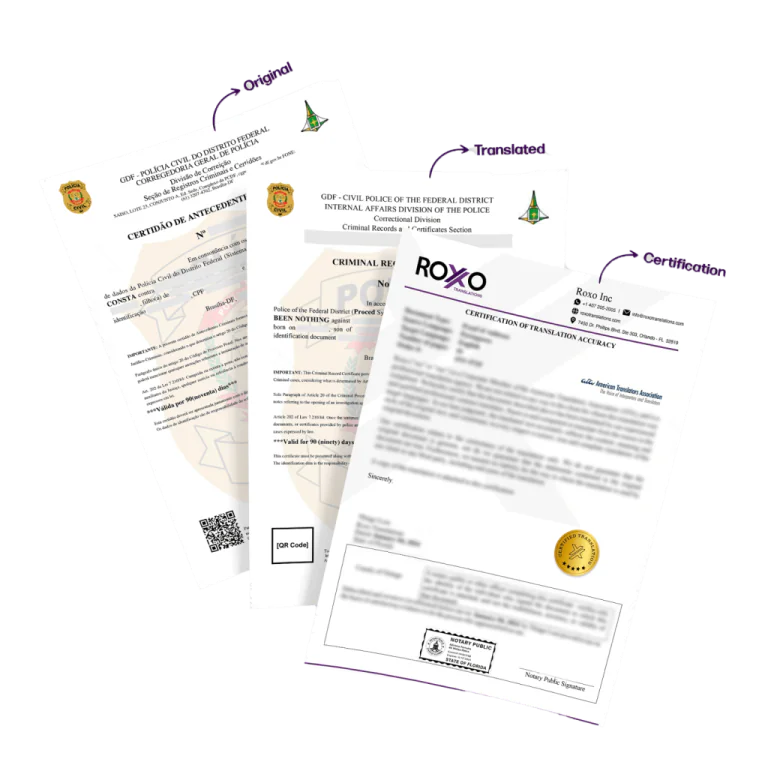

Here are some of our most requested languages
USCIS-accepted certified translations, with fast turnaround for clients across the United States.
Tailored Industry Solutions for Seamless Translations
Turnaround, price, accepted documents and how to order: the most common questions are already answered in the Help Center, organized by topic.
Articles and content from the Roxo Translations team about translation, languages, and culture.

100% Satisfied Customers
Updated on





 Vaccination Record
 Passport
 Financial Statement
 Death Certificates
 Medical Records
 Marriage Certificate
 Criminal Record
 Diploma
 Legal Contract
 Divorce Documents
 Sworn Affidavits
 Academic Transcripts
 Patent Application
 Driving License
 Birth Certificate
 Arabic
 Chinese
 French
 German
 Italian
 Japanese
 Korean
 Portuguese
 Russian
 Spanish
 Vietnamese