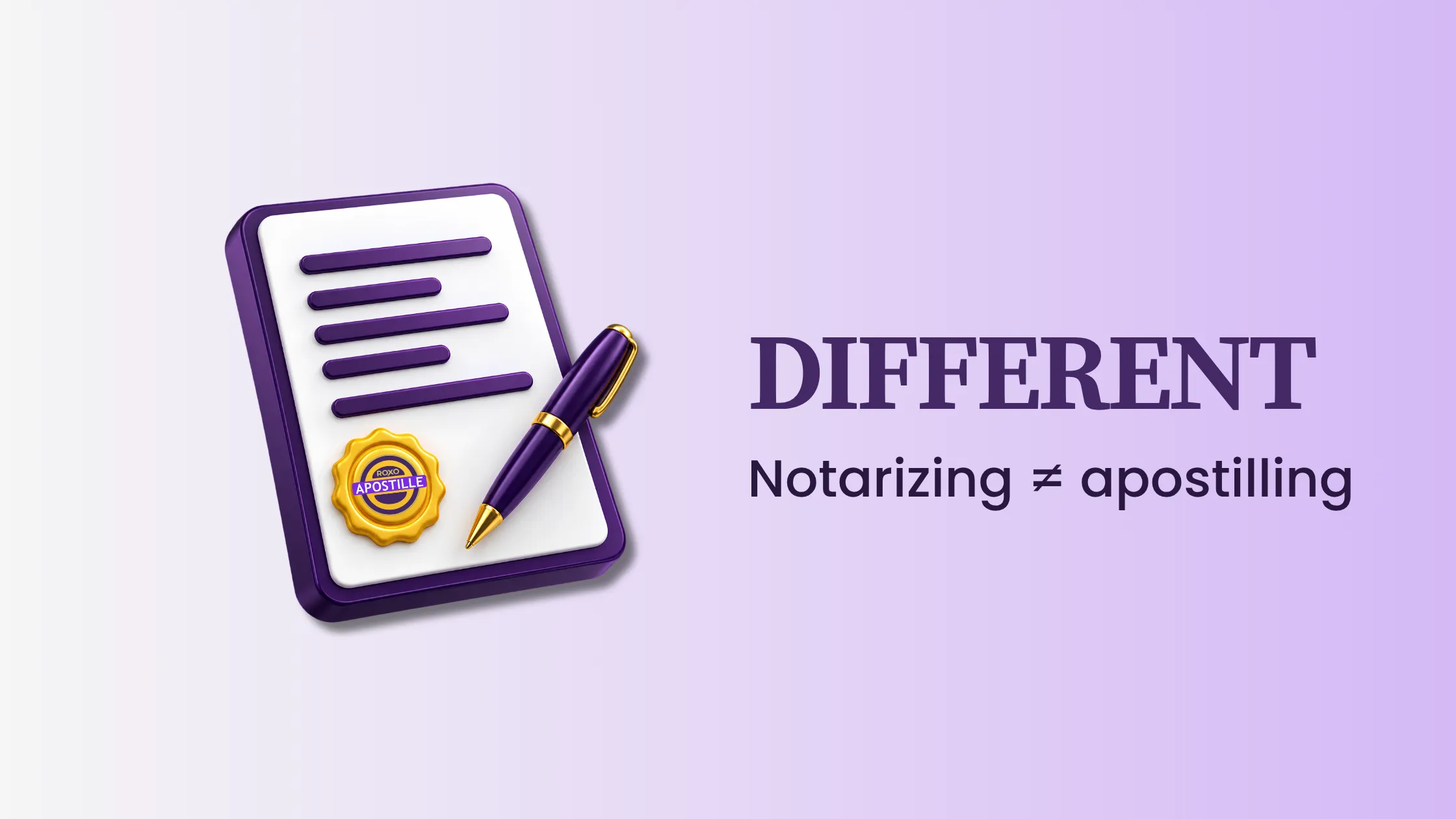
Apostille vs notary comes down to who does it and what is confirmed. Notarization is a Notary Public confirming the identity of the person who signed a document. An apostille is issued by a government authority and authenticates the signature and seal of a public official, so the document is accepted in another Hague Convention country.
Because the two often show up in the same process, it is common to think one replaces the other. It does not, and mixing them up is one of the fastest ways to get a document rejected.

Key takeaways
- Notarization confirms who signed. It does not assess the content of the document.
- An apostille authenticates the signature and seal of a public official, so the document is valid in another Hague Convention country.
- A private document is often notarized first and apostilled afterwards: one step prepares the other.
- In the United States, a notarized photocopy of a certificate usually cannot be apostilled: the state apostilles the certified copy issued by the agency itself.
- For USCIS, a certified translation needs neither notarization nor an apostille.
Contents
- What notarizing is
- What apostilling is
- Apostille vs notary, side by side
- When both apply together
- The most common mistake: the notarized copy
- Frequently asked questions
What notarizing is
Notarizing means having a Notary Public confirm the identity of the person who signed a document. The notary checks who the person is and records that they were the one who signed, with the notary's own seal and signature. The notary does not read the document to say whether the content is correct: notarization is about the signature, not about what is written.
What apostilling is
Apostilling means attaching to the document the apostille of the 1961 Hague Convention, issued by an authority of the country where the document was issued. In the United States, that is the Secretary of State of each state, or the federal Department of State for federal documents; in Brazil, the notary offices (cartórios) authorized by the CNJ. The apostille authenticates the signature and seal of the public official who issued or signed the document, so it is accepted in another Convention country. It does not assess the content either.
Apostille vs notary, side by side
| Notarization | Apostille | |
|---|---|---|
| Who does it | A Notary Public | A government authority of the country that issued the document |
| What it confirms | The identity of the person who signed | The signature and seal of a public official |
| What it is for | Securing a signature | Making the document valid in another Hague Convention country |
| Does it assess the content? | No | No |
When both apply together
A private document, such as a power of attorney or a declaration you signed, has no public official's signature. That is why it is often notarized first: the notary's signature is what the authority will apostille afterwards. A certificate issued by a vital records office, on the other hand, already carries a public official's signature, and the path is usually different.
The most common mistake: the notarized copy
In the United States, states apostille the certified copy issued by the vital records office itself. A photocopy of the certificate, even notarized, usually does not get an apostille, and it is the number one reason for rejection. If you are going to apostille an American certificate, first order the certified copy from the state that issued the document.
Frequently asked questions
Are notarizing and apostilling the same thing?
No. Notarization is a Notary Public confirming the identity of the person who signed. An apostille is issued by a government authority and authenticates the signature and seal of a public official, so the document is valid in another Hague Convention country.
Can a notarized copy of an American certificate be apostilled?
Usually not. States apostille the certified copy issued by the vital records office itself. A notarized photocopy is the number one reason for rejection, so first order the certified copy from the issuing state.
Does USCIS require a notarized or apostilled translation?
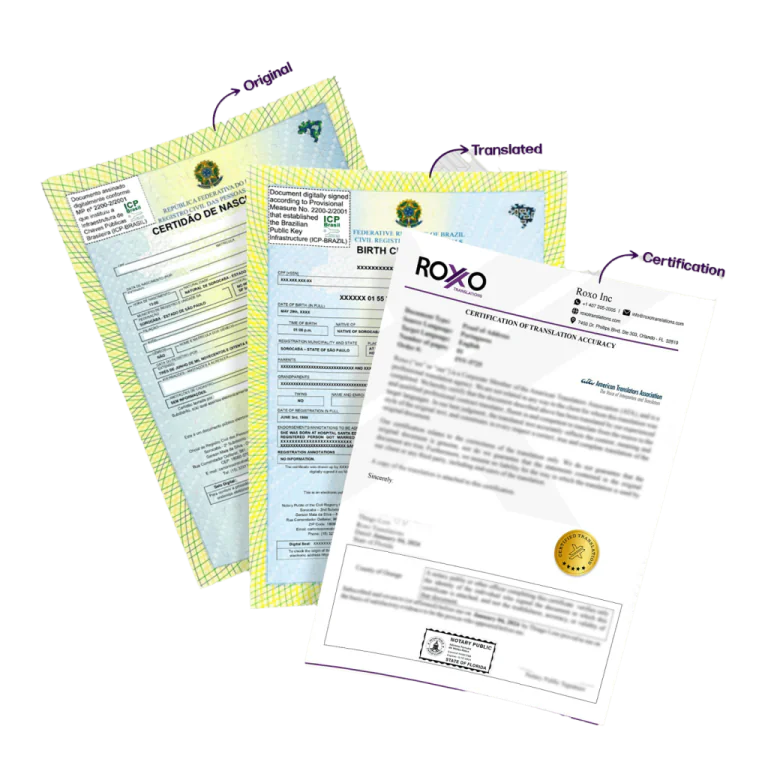
No. USCIS asks for a certified translation, with the translator's signed statement on accuracy and competence. Ours includes US notarization anyway, because some schools, courts and other agencies ask for it.
Is a notarization done in Florida valid in other states?
Yes, a notarization done in Florida is recognized throughout the United States.
Does your document need notarization, an apostille or both?
Now you know what each one confirms. In the next posts of this series, we will look at the order between the original, the apostille and the translation. If you already know you need to apostille a document, talk to us.
Related topics: apostille services | certified translation | certified translation for USCIS | help center
Related article: What does a Hague Apostille authenticate?
















 Birth Certificate
  Marriage Certificate
  Divorce Documents
  Academic Transcripts
  Medical Records
  Diploma
  Legal Contract
  Rental Contract
  Patent Application
  Statement
  Death Certificates
  Financial Statement
  Sworn Affidavits
  Driving License
  Vaccination Record
 Arabic
  Chinese
  French
  German
  Italian
  Japanese
  Korean
  Portuguese
  Russian
  Spanish
  Vietnamese