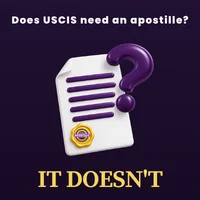
Does USCIS require an apostille? No. USCIS requires a certified translation, not an apostille. Apostilling a document for US immigration is an expense with no function. If another agency in your process asks for an apostille, then it is worth checking which one and why.
The mix-up is common because apostilles and translations go together for many destinations. For USCIS, though, what counts is the complete translation with the translator’s signed statement.
Key takeaways
- USCIS does not require an apostille: apostilling for US immigration is an expense with no function.
- What USCIS asks for is a certified translation: complete, with the translator’s signed statement.
- USCIS does not require notarization either, although some other agencies do.
- If another agency in your process asks for an apostille, tell us which one: the rule depends on who receives it.
- An apostille is for a document to be valid in another country of the Hague Convention.
Table of contents
- What USCIS asks for instead of an apostille
- Why an apostille does not help with USCIS
- When an apostille comes into your process
- FAQ
What USCIS asks for instead of an apostille
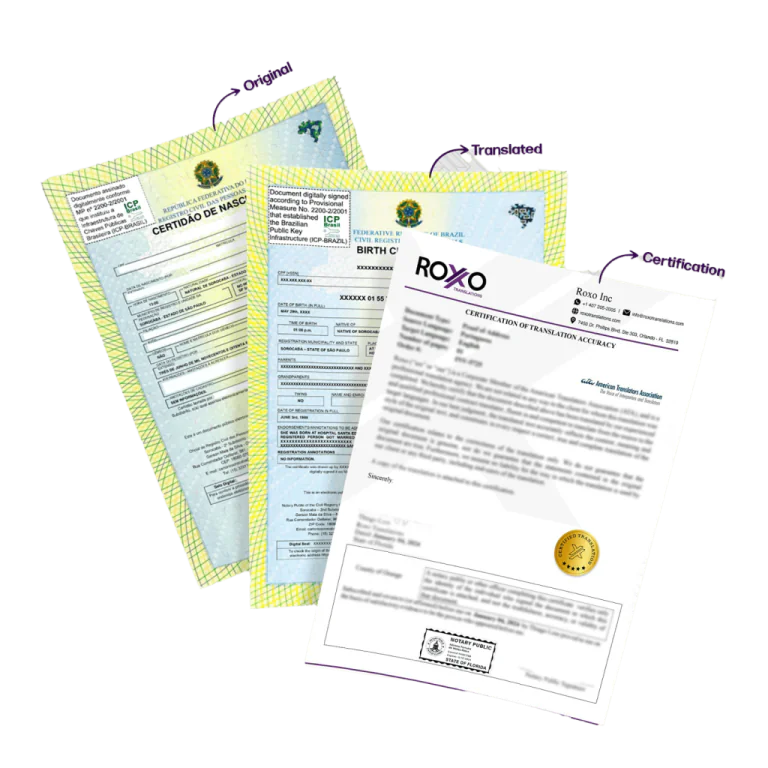
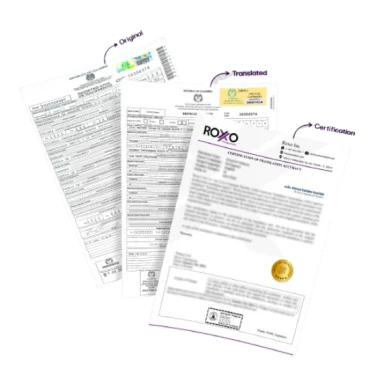
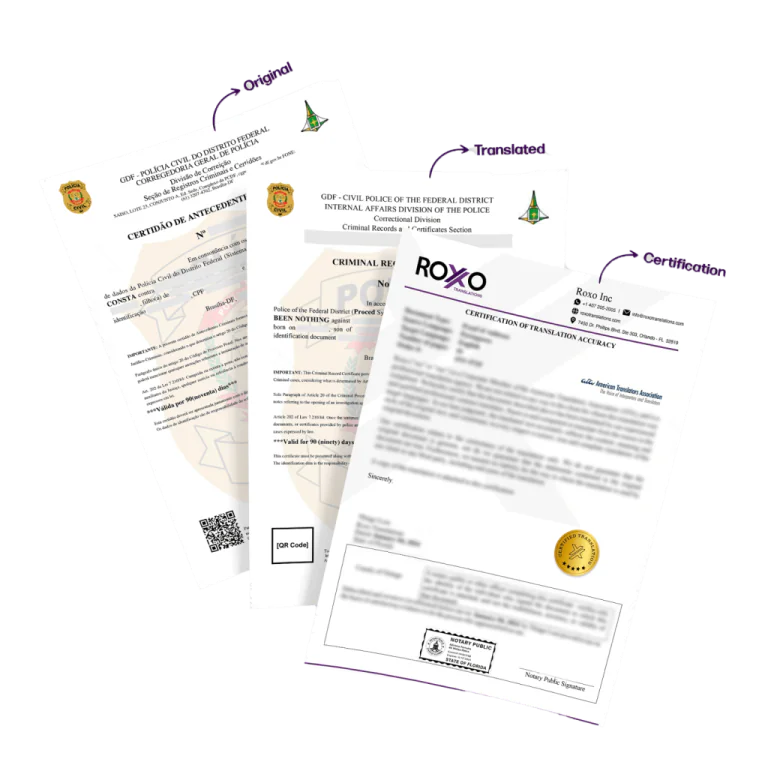
For any document in a foreign language, USCIS asks for a complete English translation and a signed statement from the translator that they are competent in both languages and that the translation is complete and accurate (8 CFR 103.2(b)(3)). That statement is the certificate of accuracy. USCIS does not require notarization, but at Roxo it is already included, because other agencies sometimes ask for it.
Why an apostille does not help with USCIS
An apostille authenticates the signature and office of whoever issued the document, so that it is valid in another country of the Hague Convention. USCIS does not ask for that authentication: it reviews the document and the certified translation. Paying for an apostille for an immigration case adds nothing to that review.
| What USCIS asks for | What USCIS does not ask for |
|---|---|
| A complete English translation | An apostille on the document |
| The translator’s signed statement (certificate of accuracy) | A notarized translation |
| Translation of stamps, seals and annotations | A Brazilian sworn translation |
When an apostille comes into your process
An apostille comes in when a document needs to be valid outside the country that issued it, for an agency other than USCIS: for example, a US certificate going to Brazil. If someone in your process asked for an apostille, tell us which agency: we check what it requires before you pay.
FAQ
Does USCIS require an apostille?
No. USCIS requires a certified translation, not an apostille. Apostilling a document for US immigration is an expense with no function.
Does USCIS require a notarized translation?
No. USCIS asks for the translator’s signed statement. Some other agencies ask for notarization, which is why it is included in Roxo’s certified translation.
What if another agency asks for an apostille?
Tell us which agency asked. The requirement depends on who receives the document, and we confirm it before you pay.
Do I need a sworn translation for USCIS?
No. For the United States, the request is usually for a certified translation. A sworn translation is the requirement for use in Brazil.
Sending documents to USCIS?
Skip the apostille and invest in the right translation: complete, with a signed certificate of accuracy and a double human review.
Related topics: certified translation for USCIS | apostille services | certified translation | help center
Related article: Which certificates need certified translation?















 Driving License
 Marriage Certificate
 Academic Transcripts
 User Manual
 Patent Application
 Brochures
 Death Certificates
 Diploma
 Power of Attorney
 Resume
 Court Documents
 Business License
 Name Change
 Passport
 Criminal Record

 Arabic
 Chinese (Simplified)
 French
 German
 Italian
 Japanese
 Korean
 Portuguese (Brazil)
 Russian
 Spanish
 Vietnamese