When someone searches for translation services, they’re rarely looking for “just a translation.” Most people are trying to solve a high-stakes problem: submitting documents for immigration, USCIS, school, legal purposes, international business, or official applications.
That’s why “professional standard” matters.
A professional translation is not only about using the correct words. It’s about delivering a translation that is: accurate and complete, consistent in names, dates, and formatting, appropriate for official review, and reliable enough to avoid delays, rejections, or costly rework. In this article, you’ll learn what professional translation really means, when you need certified translation, how to avoid common mistakes, and how to choose a provider that keeps your process moving. What does “professional standard” translation mean? Professional translation is a workflow, not a quick rewrite.
A professional standard typically includes: 1) Accuracy and completeness The translation should reflect the original meaning, including details like: names and places, dates and numeric values, official titles and institutional terms, stamps, seals, and notes (when relevant). 2) Consistency across documents Consistency is one of the biggest reasons official submissions fail.
Examples of inconsistency: changing spelling (José vs Jose), switching surname order, using different date formats across documents, translating proper nouns that should not be translated. Professional translation keeps these details stable across your entire document set. 3) Clean formatting for review Many agencies and institutions review documents quickly. A translation that mirrors the original layout makes verification faster and reduces questions. 4) Quality assurance (review) Professional providers include a second step: proofreading or review. This catches: missing lines, formatting gaps, terminology issues, typos and punctuation errors, inconsistencies in names and numbers. Certified translation vs professional translation: what’s the difference? This is one of the most common questions. Professional translation Best when you need high-quality translations for: business documents, marketing materials, internal corporate needs, general official use (depending on institution). Certified translation Often required for: immigration filings (including USCIS-related processes), birth certificates, marriage certificates, divorce decrees, academic transcripts and diplomas, court and legal submissions. A certified translation typically includes a certification statement confirming accuracy and completeness. Requirements vary by institution, so it’s smart to confirm what they ask for. Why “multiple languages” adds complexity (and risk) Many providers can translate popular language pairs, but “multiple languages” introduces more opportunities for errors if the process isn’t controlled. Where mistakes often happen: Names are formatted differently in different languages. Date formats change (MM/DD/YYYY vs DD/MM/YYYY). Official terminology can vary widely between language pairs. Transliteration rules can cause inconsistent spelling (especially with non-Latin alphabets). A professional workflow reduces these risks by standardizing rules before translation begins.
Common mistakes that cause delays or rejections If you want to save money and time, these are the issues to avoid: Mistake #1: Inconsistent names across documents Even a small difference can raise questions.
How to avoid: Use the spelling from your passport or official ID as the master reference. Mistake #2: Wrong date format interpretation “03/07/2025” can mean March 7 or July 3 depending on the country.
How to avoid: Confirm the original date format and keep it clear in translation. Mistake #3: Missing stamps, seals, or handwritten notes Some institutions expect stamps and notes to be represented in the translation.
How to avoid: Ensure the provider includes all visible content when required. Mistake #4: Partial translations Translating only the “main paragraph” can be a problem for official review.
How to avoid: Request a complete translation. Mistake #5: Over-literal translation Word-for-word translations can sound unnatural and even incorrect in legal or official contexts.
How to avoid: Use professional translators familiar with official document conventions. Practical steps to get a “professional standard” translation (fast) If you want speed without sacrificing quality, here’s a simple process that works. Step 1: Gather your full document set If you are submitting multiple documents, send them together. This helps maintain consistent spelling, formatting, and terminology across the entire package. Step 2: Confirm the purpose of the translation Tell the provider if this is for: USCIS / immigration, school/university, court/legal, employment, business or corporate use. Each use case can change formatting and certification needs. Step 3: Specify the language pair clearly Example: Spanish → English Portuguese → English French → English If you need multiple target languages, list them upfront. Step 4: Confirm how names should appear If your documents show different spellings, clarify the correct spelling based on your ID. Step 5: Set a deadline (and time zone) This avoids mismatched expectations and helps delivery planning. Which documents most often need professional or certified translation? These are among the most common: Birth certificates Marriage/divorce certificates Academic transcripts and diplomas Passports and IDs (depending on use) Driver’s licenses (case-dependent) Court documents Business and corporate documents Many people search terms like “certified translator near me” or “document translation services” because they need reliability, not just a translated paragraph. “Near me” vs online translation: which is better? People often search “where can I translate my documents near me,” but online professional translation is often the most efficient option, especially for multiple languages. Choose local if: you need physical pickup/drop-off, you want in-person support, your institution requires local handling. Choose online if: you want speed and convenience, you need multiple language pairs, you want a streamlined process (upload → review → delivery). How to choose a translation provider you can trust Here’s what to look for: Clear standards They explain how they handle names, dates, formatting, and review. Quality review included A professional process is never “one-person, one-pass.” Experience with official use They understand document structure and institutional expectations. Fast delivery without shortcuts Speed should not mean “skipping review.” Final recommendation If your translation is for official use, the cheapest option is rarely the best option, because mistakes create delays and rework.
The best value is a professional standard translation done right the first time: accurate, consistent, well-formatted, and properly reviewed.
If you need professional translation in multiple languages, especially for official purposes, Roxo Translations can help you get it done with a reliable standard and clear guidance.
Related topics: professional translation services | certified translator near me | document translation services | online document translator | Spanish translation to English
Related article: Certified Translations for USCIS: Everything You Need to Know













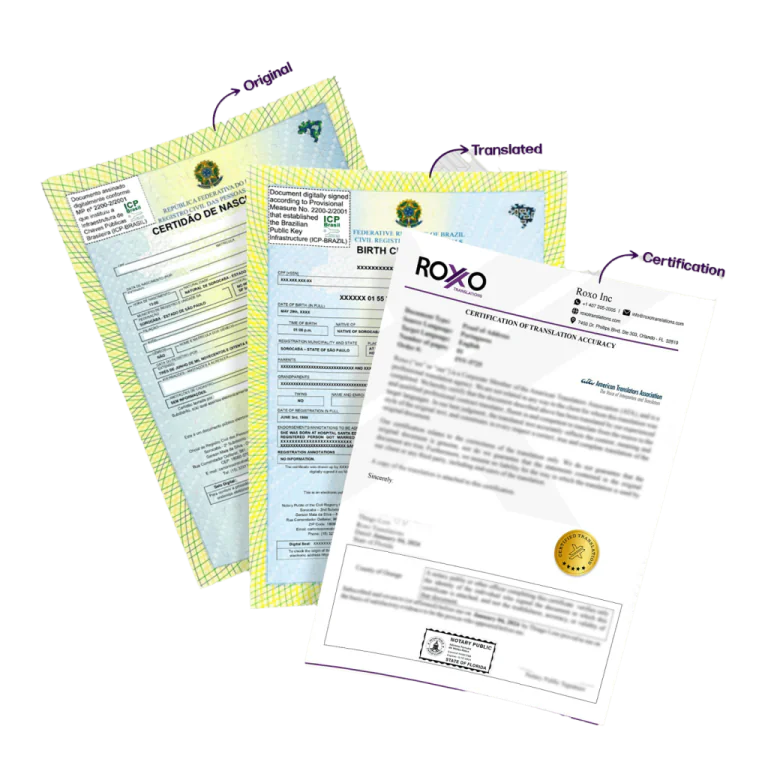
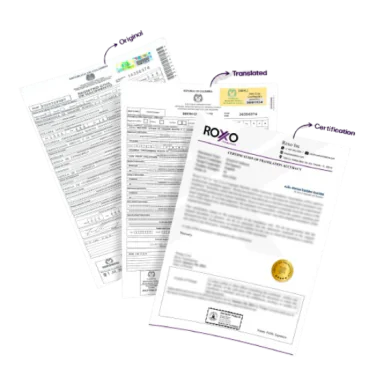
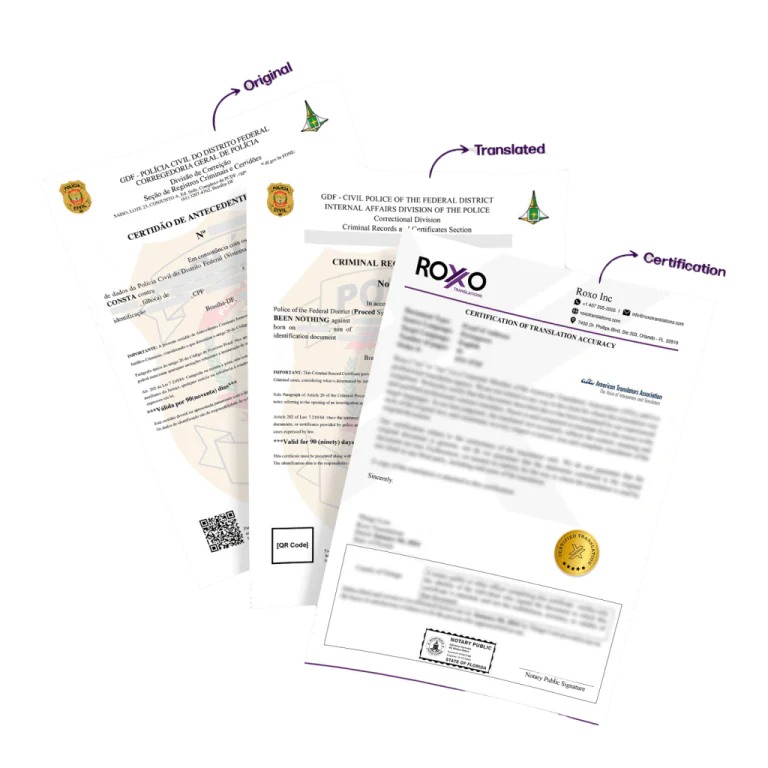
 Birth Certificate
  Marriage Certificate
  Divorce Documents
  Academic Transcripts
  Medical Records
  Diploma
  Legal Contract
  Rental Contract
  Patent Application
  Statement
  Death Certificates
  Financial Statement
  Sworn Affidavits
  Driving License
  Vaccination Record
 Arabic
  Chinese
  French
  German
  Italian
  Japanese
  Korean
  Portuguese
  Russian
  Spanish
  Vietnamese