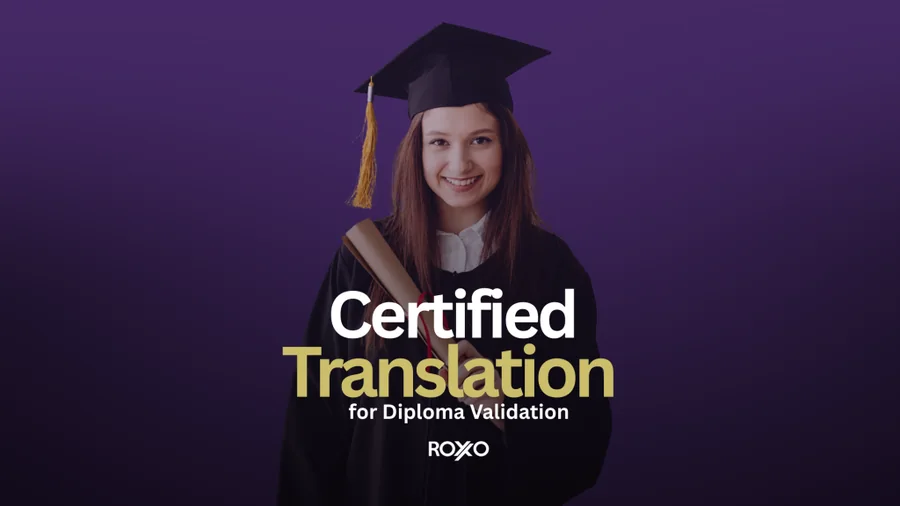
Validating your diploma abroad is a crucial step if you want to study, work, or advance your career in another country. But most people only discover one key requirement at the last minute: you must submit a certified translation of your academic documents.
Diplomas, transcripts, course descriptions, certificates, and even internship declarations, all must be translated accurately and accompanied by a certification statement to be accepted by foreign institutions.
In this complete guide, you will learn:
Why certified translation is required
Who needs it and who demands it
How diploma validation works
How to choose the right translation service
Common mistakes that delay or block approval
Professional tips to speed up your process
Contents
- 1. What Is a Certified Translation, and Why It Is Required
- Why Certified Translation Is Essential for Diploma Validation
- 3. Common Mistakes That Cause Rejection or Delays
- 4. How to Get Your Certified Translation Done Correctly
- 5. Professional Tips to Ensure Your Diploma Validation Is Successful
- 6. Why Roxo Translations Is the Best Choice for Certified Academic Translations
- 7. Final Thoughts: Your Diploma Deserves Global Recognition
1. What Is a Certified Translation, and Why It Is Required
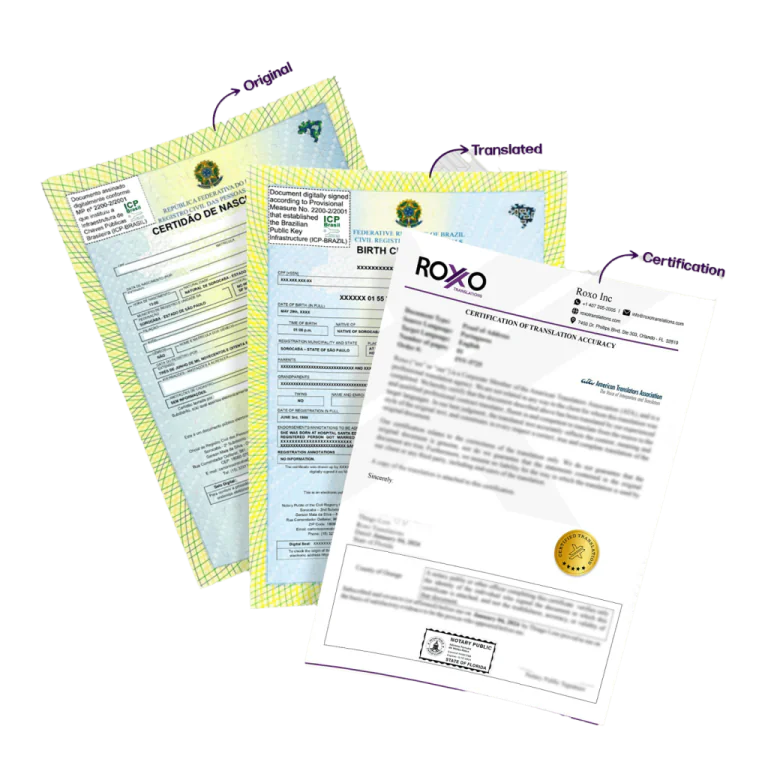
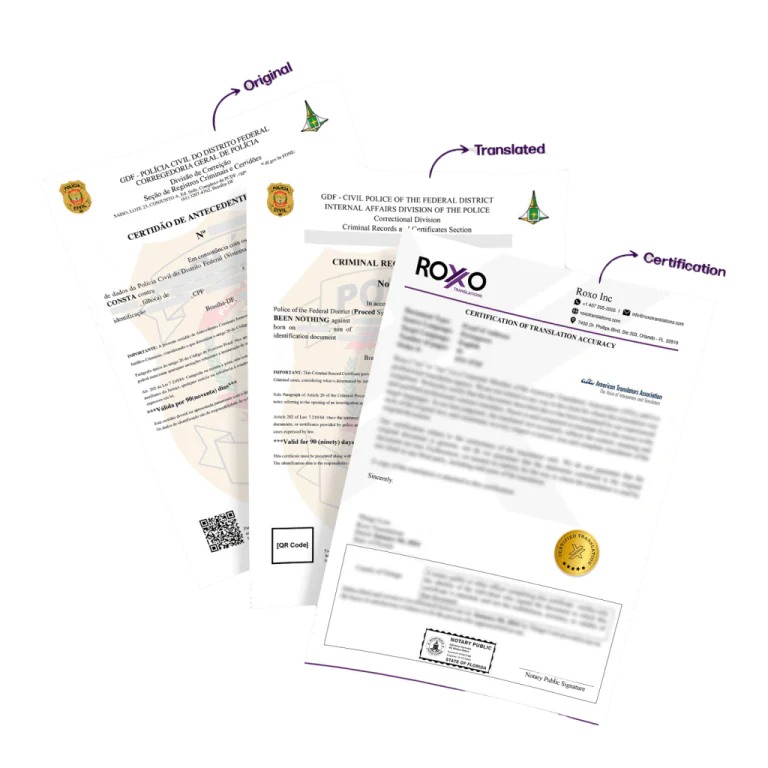
A certified translation is an official translation that includes a signed certificate from the translator confirming that the translation is complete, accurate, and faithful to the original document.
In the United States, certified translations are required by:
Universities
Employers
Professional licensing boards
Credential evaluation agencies (WES, ECE, IERF, SpanTran, Josef Silny, etc.)
USCIS for immigration processes
USCIS clearly states:
“Any document containing foreign language submitted to USCIS must be accompanied by a full English translation and a certification from the translator that the translation is complete and accurate.”
This requirement makes certified translation non-negotiable.
A regular translation, automated translation, or one done by a bilingual friend will not be accepted.
Why Certified Translation Is Essential for Diploma Validation
When submitting your academic documents for evaluation in another country, institutions follow a very structured process:
Verification of the original documents
Submission of certified translations
Evaluation by an official credential agency
Approval or rejection by the institution
If your translation does not meet official standards, your application may be:
Delayed
Returned for correction
Rejected entirely
This can cost time, money, and important academic or professional deadlines.
Common documents that require certified translation:
Diplomas (undergraduate, graduate, postgraduate)
Transcripts
Course descriptions (syllabus)
Statements of completion
Internship certificates
Technical course certificates
Specialization certificates
Academic reports and letters
Missing even one translation can halt your process.
3. Common Mistakes That Cause Rejection or Delays
Over the years, thousands of applicants experience the same problems, most of them easily avoidable.
1. Using non-certified translators
Even if someone speaks the language fluently, institutions will not accept their work unless it includes proper certification.
2. Incomplete translations
Every detail must be translated:
Seals
Stamps
Footnotes
Signatures
Headers
Side notes
Omitting any part leads to rejection.
3. Incorrect document formatting
The translated document must match the structure of the original.
Major layout changes can raise concerns of document tampering.
4. Using Google Translate or automated tools
No institution accepts machine-generated translations for official evaluations.
5. Starting the process too late
Credential evaluations can take weeks.
If you wait until the last minute, you might miss application deadlines.
4. How to Get Your Certified Translation Done Correctly
Follow this step-by-step plan to ensure your documents are accepted without issues.
Step 1: Confirm What Your Institution Requires
Before translating anything, verify:
Which documents must be translated
Whether apostilles or notarizations are required
If translations must be submitted separately
Whether digital copies are accepted
Each agency has its own rules, especially WES, ECE, and SpanTran.
Step 2: Use a Professional Certified Translation Service
Roxo Translations delivers:
Certified translations accepted across the U.S.
High accuracy with professional translators
Fast turnaround times
7-day support
Translations available in English, Spanish, Portuguese, French, and Italian
Our certified translations meet requirements from:
USCIS
Credential agencies (WES, ECE, IERF, SpanTran, Josef Silny)
Universities and professional boards
This ensures your translation will not be rejected.
Step 3: Review and Approve Your Translation
You receive a digital copy for review before the final certification.
This helps ensure all names, dates, and academic details are correct.
Step 4: Submit to the Evaluation Agency or University
Most institutions accept certified translations digitally, which speeds up your application.
5. Professional Tips to Ensure Your Diploma Validation Is Successful
Submit all documents together
Reduces the risk of delays and additional requests.
Never translate your own documents
Institutions will reject self-translated material.
Check the specific guidelines of your agency
Some require sealed envelopes, digital uploads, or direct submissions.
Keep copies of everything
You may need to resubmit documents later.
Ask whether notarization is required
Some boards (especially medical and legal) may request it.
6. Why Roxo Translations Is the Best Choice for Certified Academic Translations
Roxo Translations offers industry-leading services for diploma validation:
Certified translations accepted in the U.S.
Compliant with institutional and USCIS standards.
Academic document specialists
Experienced translators for transcripts, diplomas, and course descriptions.
Fast delivery
Ideal for urgent academic or professional deadlines.
7-day customer support
Service in English, Portuguese, and Spanish.
Over 1,500 five-star reviews on Google
A trusted leader in the translation field.
Choosing Roxo means avoiding delays, ensuring accuracy, and completing your validation process smoothly.
7. Final Thoughts: Your Diploma Deserves Global Recognition
Validating your diploma abroad opens the door to:
New academic opportunities
Professional licensing
Career advancement
Higher salaries
International work possibilities
But none of this moves forward without one essential step:
a proper certified translation of your academic documents.
Roxo Translations helps students and professionals worldwide get their documents accepted quickly, accurately, and with confidence.
Related topics: Certified translation for academic documents | How to validate your diploma in the U.S. | USCIS certified translation requirements | Transcript translation services | WES document translation










 Birth Certificate
  Marriage Certificate
  Divorce Documents
  Academic Transcripts
  Medical Records
  Diploma
  Legal Contract
  Rental Contract
  Patent Application
  Statement
  Death Certificates
  Financial Statement
  Sworn Affidavits
  Driving License
  Vaccination Record
 Arabic
  Chinese
  French
  German
  Italian
  Japanese
  Korean
  Portuguese
  Russian
  Spanish
  Vietnamese