Contents
- 1. Introduction: A Language That Shaped a Nation
- 2. The Arrival of English in the New World
- 3. Influence of Native American Languages
- 4. The Impact of Immigration and Cultural Diversity
- 5. The American Revolution and Linguistic Independence
- 6. Regional Dialects and the Growth of American Identity
- 7. The Rise of American Literature and Media
- 8. Technology and the Modern Evolution of American English
- 9. British vs. American English: Key Differences
- 10. English as a Global Power, Led by the U.S.
- 11. The Future of American English
- 12. Conclusion: A Living, Breathing Language
1. Introduction: A Language That Shaped a Nation
The English language has become one of the most powerful tools of communication worldwide, but the version spoken in the United States has a unique story. The language that began as the tongue of British settlers evolved over centuries into American English, a distinct and influential dialect that reflects the country’s diverse history, culture, and identity.
Understanding the origin of English in the United States means tracing a journey through colonization, immigration, innovation, and globalization, all of which shaped not just how Americans speak, but also how they think, create, and connect with the world.
2. The Arrival of English in the New World
English first arrived in North America in the early 1600s, with the establishment of Jamestown, Virginia, in 1607. The settlers came primarily from England, bringing with them the early forms of Early Modern English, which had already been influenced by Shakespearean vocabulary and Elizabethan grammar.
At that time, English was far from standardized. Different regions of England had their own accents and expressions, and when settlers crossed the Atlantic, they carried these regional differences with them. Over time, isolation, local adaptation, and contact with other languages transformed the way they spoke.
In other words, the English spoken in colonial America was not the same as the English of London, and it quickly began to evolve into something new.
3. Influence of Native American Languages
When English settlers arrived, they encountered the rich linguistic diversity of Native American tribes, each with its own distinct language. These encounters left a permanent mark on the English spoken in the colonies.
Words like canoe, barbecue, moccasin, hammock, and tobacco came from Native American languages. Many geographical names, such as Massachusetts, Connecticut, Mississippi, and Chesapeake, also originate from Indigenous words.
These terms filled a linguistic gap: settlers needed new words to describe plants, animals, and landscapes they had never seen before. As a result, Native American vocabulary became an integral part of early American English.
4. The Impact of Immigration and Cultural Diversity
By the 18th and 19th centuries, the United States became a melting pot of cultures and languages. Immigrants from Germany, the Netherlands, France, Ireland, Africa, and later Italy and Eastern Europe brought their own linguistic influences.
For example:
German immigrants introduced words like kindergarten, dachshund, and hamburger.
Dutch settlers gave us cookie (from koekje) and boss (from baas).
African languages influenced vocabulary in the South and the Caribbean, especially through the development of Creole and African American Vernacular English (AAVE).
Each new wave of immigration added flavor and rhythm to the evolving American English, making it a true reflection of cultural diversity.
5. The American Revolution and Linguistic Independence
When the American Revolution (1775-1783) ended, the new nation sought to establish its independence, not only politically but linguistically.
This was the beginning of a distinct identity for American English. Noah Webster, often called the father of American English, published his American Dictionary of the English Language in 1828. His goal was to create a version of English that reflected the new nation’s values and simplicity.
Webster’s reforms included:
Simplifying spellings (color instead of colour, center instead of centre).
Promoting American pronunciations and idioms.
Encouraging a sense of unity through standardized education.
Webster’s influence was monumental, his dictionary not only standardized American spelling but also solidified linguistic independence from Britain.
6. Regional Dialects and the Growth of American Identity
As settlers moved westward, new regional dialects developed, shaped by geography, climate, and culture.
The Southern drawl, New England accent, Midwestern plain speech, and New York slang all evolved as people adapted to different environments and interacted with different cultural groups.
For example:
The Southern dialect was influenced by African American speech and Scottish-Irish settlers.
New England English retained many archaic British features.
Western English became more neutral and later served as the foundation for what we call General American English, the “standard” accent used in broadcasting and education.
This linguistic diversity mirrors the broader American experience: unity through difference.
7. The Rise of American Literature and Media
By the 19th century, American writers and thinkers began to celebrate their unique voice. Authors like Mark Twain, Walt Whitman, and Emily Dickinson wrote in ways that reflected the sounds and rhythms of American life, not British formality.
Later, the rise of Hollywood films, radio, and television in the 20th century helped spread American English around the world. Through popular culture, from Elvis Presley to Beyoncé, the English spoken in the U.S. became a global standard of entertainment and communication.
Today, American English dominates global media, influencing spelling, slang, and pronunciation in international contexts.
8. Technology and the Modern Evolution of American English
The digital revolution has transformed how Americans use English. Social media platforms like Twitter, TikTok, and Instagram have given rise to a new kind of language, one that’s shorter, faster, and highly expressive.
Acronyms like LOL, OMG, and BRB emerged from online chat culture. Emojis now complement text as visual extensions of emotion. Slang evolves daily, reflecting generational shifts and technological innovation.
Interestingly, American English continues to lead global digital communication, influencing how people write and speak in English worldwide.
9. British vs. American English: Key Differences
Although they share the same roots, British and American English have diverged in vocabulary, spelling, and pronunciation. Here are a few quick examples:
Comparison Table: British vs. American English| British English | American English |
|---|---|
| Colour | Color |
| Centre | Center |
| Lift | Elevator |
| Flat | Apartment |
| Holiday | Vacation |
| Petrol | Gasoline |
| Biscuit | Cookie |
While these differences sometimes cause confusion, they also highlight the adaptability and richness of the English language.
10. English as a Global Power, Led by the U.S.
Today, the United States plays a leading role in maintaining English as the world’s global language. It’s the language of technology, business, entertainment, and academia.
More than 1.5 billion people around the world speak English, many learning it through American films, songs, and education systems. The global dominance of American English reflects the country’s cultural and economic influence in the modern world.
11. The Future of American English
As immigration, technology, and globalization continue to evolve, so will American English. New dialects, inclusive language movements, and multicultural influences are reshaping how people communicate.
The future of English in the United States is likely to be even more diverse, flexible, and creative, a mirror of the society it represents.
12. Conclusion: A Living, Breathing Language
The story of the English language in the United States is the story of America itself, one of diversity, innovation, and resilience. From the early settlers of Jamestown to the era of smartphones, American English has evolved continuously, reflecting the people who speak it.
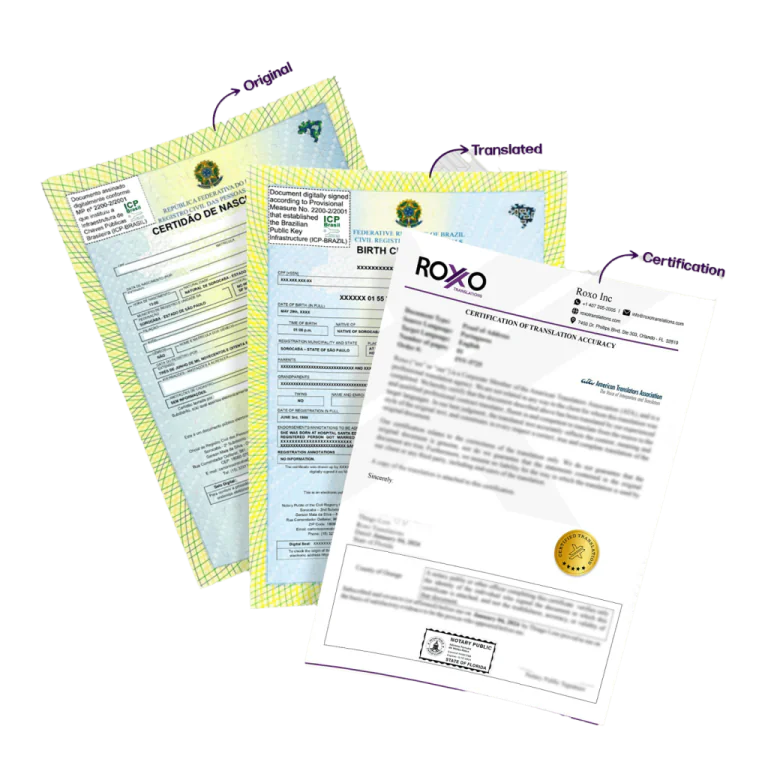
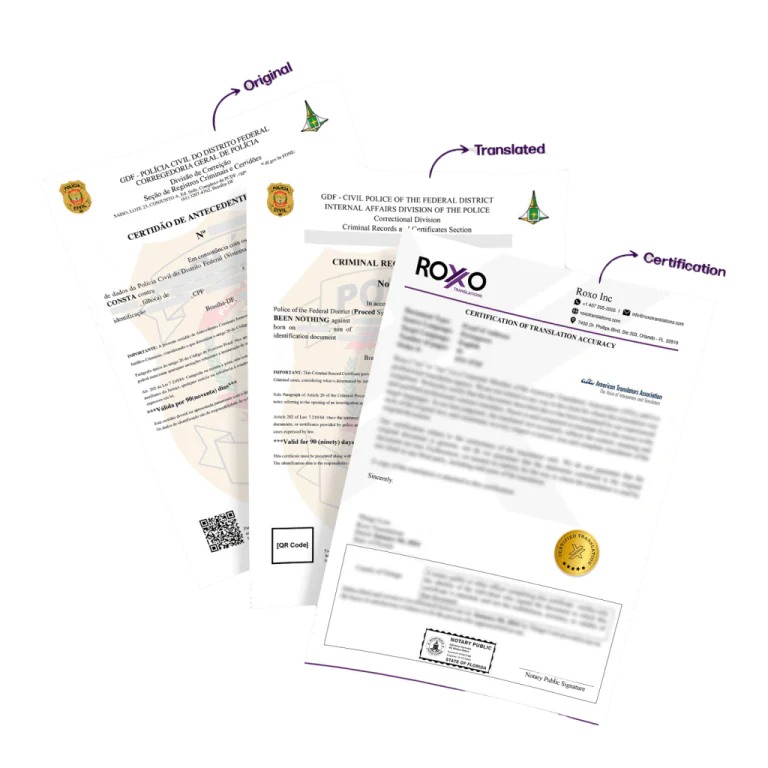
At Roxo Translations, we understand the power of language to connect cultures and create opportunities. Whether you need a certified translation for immigration, business, or education, we ensure your message is clear, accurate, and true to its origin, just like the evolution of English itself.
Related topics: History of American culture and language | Differences between British and American English | Why certified translations matter in the U.S. | The evolution of global English | How immigration shaped modern language
















 Birth Certificate
  Marriage Certificate
  Divorce Documents
  Academic Transcripts
  Medical Records
  Diploma
  Legal Contract
  Rental Contract
  Patent Application
  Statement
  Death Certificates
  Financial Statement
  Sworn Affidavits
  Driving License
  Vaccination Record
 Arabic
  Chinese
  French
  German
  Italian
  Japanese
  Korean
  Portuguese
  Russian
  Spanish
  Vietnamese