











 Employee Handbook
 Certificates
 Birth Certificate
 Court Documents
 Patent Application
 Legal Contract
 Spanish Medical Records
 Spanish Transcript
 Criminal Record
 Divorce Documents
 WhatsApp Messages
 Death Certificates
 Business License
 Financial Statement
 Marriage Certificate





















Turkish Translation Services
Roxo Translations offers Turkish translation services for documents from Turkey, from Cyprus and from the Turkish communities abroad, to and from English, Arabic, Italian, Russian and other languages. Every translation is done by a human translator, native in the target language, and reviewed by a second one, never by machine translation.
Send a photo or scan of the document, see the price and the deadline instantly, and receive the translation as a PDF. For the United States it comes certified and accepted by USCIS, with the signed statement and optional notarization.
- Turkish from Turkey and Cyprus, in both directions
- Certified for USCIS, with optional notarization
- Instant online quote and fast delivery

- 2,200 reviewsExcellent5.0
- 125,230documents translated
- 62,499,808words translated
Where Turkish is spoken and where your translation is accepted
Turkish is the official language of Turkey and one of the two official languages of Cyprus, and it has official status in some municipalities of Kosovo and North Macedonia. It is also spoken by Turkish communities in Bulgaria, Greece and other Balkan countries, and it has more than 80 million speakers. Emigration took Turkish to Germany, Austria, the Netherlands, France and Belgium, and later to the United States, the United Kingdom and Australia, where many families still need Turkish records. The destination decides the type of translation.

| Where | What you need |
|---|---|
| United States: USCIS, courts, universities and employers | Certified translation into English, with the signed statement of accuracy and optional notarization |
| Brazil: notary offices, universities and public agencies | Sworn translation into Portuguese, signed by a public sworn translator and valid nationwide. For Turkish, we confirm before quoting whether it goes through English |
| Turkey, Cyprus and other countries | Ask the receiving authority which format it accepts: we tell you the options before quoting, including the Hague apostille when it applies |
| Turkish consulates, citizenship and immigration processes | The translation into the language the authority asks for, with the apostille on the original when it is required |
Turkish language pairs we translate
These are the language pairs with Turkish that we translate today, in both directions.

Need a pair that is not on the list? Talk to us: we answer within one hour, 7 days a week.
Turkish translation services for Turkey, Cyprus and the diaspora
Turkish builds words by adding suffixes, one after the other, so a single word can carry what English says in a whole phrase: evlerinizden means “from your houses”. Documents from Turkey also follow their own formats. A good translation keeps every letter of the names, follows the order of the original and reads naturally to whoever receives it.
- Letters: since 1928 Turkish uses a Latin alphabet of 29 letters, with ç, ğ, ı, ö, ş and ü, and without q, w and x. The dotless ı and the dotted i are different letters, also in capitals (I and İ). American documents often drop the marks, so Öztürk becomes Ozturk and Erdoğan becomes Erdogan. The translation keeps every name exactly as in the original, so tell us the form used in your US documents when you order.
- Turkey, Cyprus and older records: the Turkish of Cyprus has its own accent and some words of its own, and Azerbaijani is a close but separate language. Records written before 1928 are in Ottoman Turkish, in the Arabic script, with many Arabic and Persian words. If your document is in Ottoman Turkish or in Azerbaijani, tell us when you order and we confirm the options before quoting.
- Names: surnames became mandatory with the Surname Law of 1934, so older records may show only a given name with a father’s name or a title such as Bey, Efendi or Ağa. Many people have two given names, such as Mehmet Ali, and a married woman may keep her maiden name before her husband’s surname, as in Ayşe Yılmaz Demir. In running text a name takes suffixes after an apostrophe, as in Ahmet’in, and the translation keeps the name as written in the identity fields.
- Dates and numbers: the months have Turkish names, so Ekim is October and Aralık is December, and dates are written day first, so 03.10.2026 or 3 Ekim 2026 is October 3, 2026. Decimals use a comma and thousands a period, so 1.500,00 is one thousand five hundred.
- Documents from Turkey: the civil registry record (nüfus kayıt örneği), the international birth extract (uluslararası doğum kayıt örneği), the marriage booklet (evlenme cüzdanı) and the ID card (kimlik kartı), which carries the 11-digit identity number (T.C. Kimlik No). Many records today come from the e-Devlet portal, with a barcode for verification. The translation reproduces every stamp, seal and note.

The history of the Turkish language
Turkish belongs to the Turkic family of languages, which came from Central Asia. The oldest long texts in a Turkic language are the Orkhon inscriptions, stone monuments carved in the 8th century in what is now Mongolia, in the Old Turkic runic script. Turkic peoples moved west over the following centuries, and after the battle of Manzikert, in 1071, the Seljuks settled in Anatolia. In the same decade, Mahmud al-Kashgari wrote the Dīwān Lughāt al-Turk, a dictionary of the Turkic languages.
From the founding of the Ottoman state, around 1299, to the 1920s, Turkish was written in the Arabic script, and the language of the court and of documents, Ottoman Turkish, took in thousands of Arabic and Persian words. The first press to print books in Turkish in the Arabic script was set up in Istanbul by İbrahim Müteferrika in 1727, and its first book, a dictionary, came out in 1729.
After the Republic of Turkey was founded, in 1923, the language law of November 1, 1928 replaced the Arabic script with the Latin alphabet used today. The Turkish Language Association (Türk Dil Kurumu), created in 1932, replaced many Arabic and Persian words with Turkish ones, and the Surname Law of 1934 gave every family a surname. Today Turkish has more than 80 million speakers, in Turkey, in Cyprus and in the communities abroad.

We also translate other languages
The Fastest Path to Your Translations
100% online
-

Send the document
-

Receive your quote
-

Human translation
-

First proofreading
-

Double proofreading
-

Fast delivery
-

Your satisfaction
We Translate All Types of Documents, Respecting the Original Format
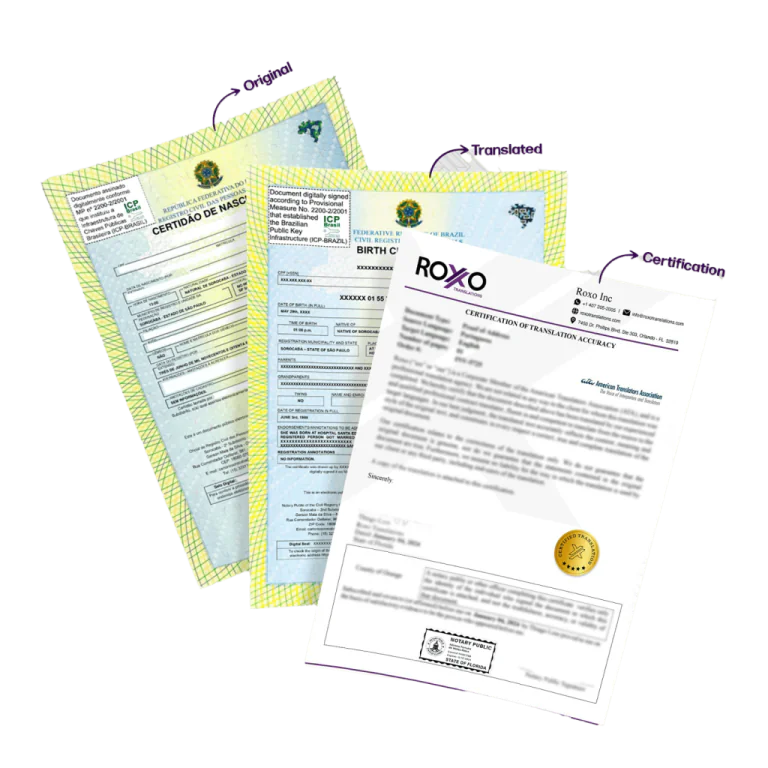
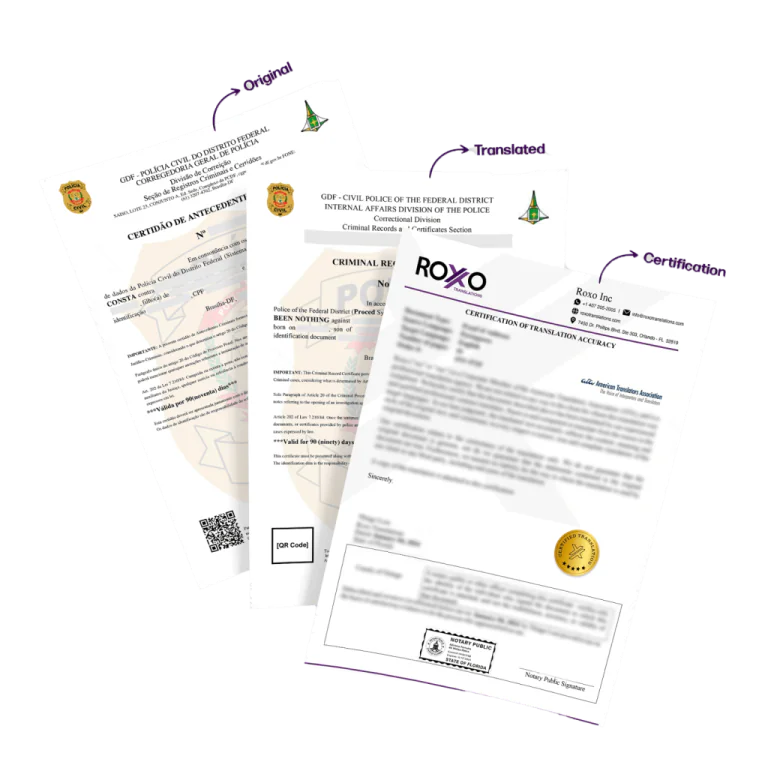
Documents we translate

Open 7 Days a Week to Serve You
Languages We Translate
Here are some of our most requested languages
 Arabic
 Chinese (Simplified)
 English (United States)
 French
 German
 Italian
 Japanese
 Korean
 Portuguese (Brazil)
 Russian
 Spanish
 Vietnamese
The 566 language pairs we translate today. Type a language to see which languages it pairs with.
Can't find your pair? Talk to us: we answer within one hour.
Certified Translation in the Main Cities of the USA
USCIS-accepted certified translations, with fast turnaround for clients across the United States.
Industry Solutions
Tailored Industry Solutions for Seamless Translations
Help Center
Turnaround, price, accepted documents and how to order: the most common questions are already answered in the Help Center, organized by topic.
Do you translate Turkish from Turkey and Cyprus, including older records?
We translate documents from Turkey and Cyprus, such as the civil registry record (nüfus kayıt örneği), birth extracts, marriage booklets and ID cards, to and from English, Arabic, Italian, Russian and other languages. Every name keeps its Turkish letters, such as ç, ğ, ı and ş, exactly as in the original. Records written before 1928 are in Ottoman Turkish, in the Arabic script: tell us when you order and we confirm the options before quoting.
A name is spelled differently from my passport. Can you change it?
The translation reproduces names exactly as they appear in the original document. If you need another spelling, such as the one in your passport, tell us when you place your order, before we start. If we made a typo, we fix it at no cost.
Can you translate between two languages other than English, such as Italian to Portuguese?
Often yes, depending on the pair and the service. For certified translation we confirm translator availability. For sworn translation into Portuguese, some pairs require a two-step route through English. We tell you the option before quoting.
What is a certified translation?
A certified translation is a complete translation signed by a qualified professional, with a statement attesting that it is accurate and complete. In the United States it is the format required by USCIS, courts, universities and most official institutions.
Which documents do you translate?
Birth, marriage and death certificates, divorce decrees, diplomas and transcripts, driver's licenses, passports and IDs, criminal records, bank and financial statements, medical and vaccination records, contracts, affidavits and court documents, among others. Send a photo and we confirm.
Is the translation done by people or by machine?
By people. Every document is translated by a professional linguist and goes through double human review for accuracy, grammar, formatting and consistency before delivery. The translator may use support tools, such as translation memory or machine translation, as an aid, but the translator who signs or certifies the work is always responsible for it.
Check Out Our Blog!
Articles and content from the Roxo Translations team about translation, languages, and culture.

Can a family member translate your documents for USCIS?
Read More
Hukou translation: how to translate a Chinese household register for USCIS
Read More
Do you need a local certified translator? What actually matters for USCIS
Read More
Italian birth certificate translation: copia integrale, estratto or certificato?
Read More
Apostille in Sacramento: where California documents are apostilled
Read More
Apostille in Florida: who issues it, which copy is accepted and the fee
Read More
Divorce decree translation for use in the US: what is actually required
Read MoreOur Clients Trust and Recommend Us
100% Satisfied Customers