










 Driving License
 Business License
 Press Release
 Academic Transcripts
 Spanish Bank Statement
 User Manual
 Birth Certificate
 Passport
 Spanish Medical Records
 Sworn Affidavits
 Emails
 Diploma
 Death Certificates
 WhatsApp Messages
 Certificates



















Latin Translation Services
Roxo Translations offers Latin translation services for baptism and marriage records, parish registers, old university diplomas and other historical documents, to and from English, Italian, Russian and Arabic. Every translation is done by a human translator, native in the target language, and reviewed by a second one, never by machine translation.
Send a photo or scan of the document, see the price and the deadline instantly, and receive the translation as a PDF. For the United States it comes certified and accepted by USCIS, with the signed statement and optional notarization.
- Parish records, baptism certificates and old diplomas in Latin
- Certified for USCIS, with optional notarization
- Instant online quote and fast delivery
- 2,200 reviewsExcellent5.0
- 125,230documents translated
- 62,499,808words translated
Where Latin is used and where your translation is accepted
Latin is no longer the native language of any country, but it is still the official language of the Holy See, and the Catholic Church still publishes its official documents in it. For centuries it was the written language of the Church, the universities and the law in Europe, so it fills old parish registers, baptism and marriage records, university diplomas and notarial deeds. Today these documents are asked for in citizenship by descent, such as Italian or Portuguese citizenship, in immigration cases and in degree evaluations. The destination decides the type of translation.
| Where | What you need |
|---|---|
| United States: USCIS, courts, universities and employers | Certified translation into English, with the signed statement of accuracy and optional notarization |
| Brazil: notary offices, universities and public agencies | Sworn translation into Portuguese, signed by a public sworn translator and valid nationwide. For Latin, we confirm before quoting whether it goes through English |
| Italy, Portugal and other countries | Ask the receiving authority which format it accepts: we tell you the options before quoting, including the Hague apostille when it applies |
| Consulates, citizenship by descent and immigration processes | The translation into the language the authority asks for, such as Italian or English, with the apostille on the original when it is required |
Latin language pairs we translate
These are the language pairs with Latin that we translate today, in both directions.

Need a pair that is not on the list? Talk to us: we answer within one hour, 7 days a week.
Latin translation services for parish records, diplomas and citizenship
The Latin of documents is not only the Latin of school books. Parish registers were written by hand, by priests who used abbreviations, local words and their own spelling, and diplomas follow formulas of their own. A good translation reads the original as it was written, keeps every name and date and reads naturally to whoever receives it.
- Classical and Church Latin: the Latin of Cicero and Virgil is not the Latin of the Church and of old registers, which spell words their own way, so ecclesiae can appear as ecclesie, and mix in words from the local language. The translation follows the meaning of the record, not a school dictionary.
- Handwriting and abbreviations: registers use short forms, such as bapt. for baptizatus (baptized), fil. for filius or filia (son or daughter) and q. or qm for quondam (the late). Handwritten documents are accepted, and any part that cannot be read is marked as illegible.
- Names: first names were written in Latin, so Giovanni or João appears as Ioannes or Joannes and Giuseppe or José as Iosephus, and the ending changes with grammatical case, so Ioannes becomes Ioannis in filius Ioannis (son of John). The translation keeps every name as written in the original, so tell us the form used in your other documents when you order.
- Dates and numbers: dates are often written in words, such as die tertia mensis Octobris (on the third day of October), and years can come in Roman numerals, so MDCCCLXXV is 1875. September to December keep the names of the old Roman calendar, in which they were the seventh to the tenth months.
- Typical documents: the book of baptisms (liber baptizatorum), of marriages (liber matrimoniorum) and of deaths (liber defunctorum), baptism and marriage certificates issued by the parish, Church dispensations, notarial deeds and university diplomas. The translation reproduces every stamp, seal and margin note.
The history of the Latin language
Latin is an Italic language of the Indo-European family, born in Latium, the region around Rome that gave it its name. One of its oldest inscriptions is on the Lapis Niger, a stone in the Roman Forum from the 6th century BC. As Rome grew from a city into an empire, Latin spread around the Mediterranean and western Europe, and in the 1st century BC Cicero, Caesar and Virgil wrote the classical Latin still read in schools.
Spoken Latin changed from region to region and gave rise to the Romance languages, among them Portuguese, Spanish, French, Italian and Romanian. Written Latin lived on: at the end of the 4th century, Jerome translated the Bible into Latin, in the version known as the Vulgate, and for more than a thousand years Latin was the language of the Church, the universities, the law and science, the language in which Isaac Newton published his Principia in 1687. In 1563, the Council of Trent required Catholic parishes to keep registers of baptisms and marriages, and many of them were written in Latin for centuries.
After the Second Vatican Council, from 1962 to 1965, Mass began to be said in local languages, but Latin remains the official language of the Holy See. It lives on in the scientific names of plants and animals, in legal terms, in mottos and on diplomas, and it is still taught in schools around the world. It is no one’s native language today, and that is why its documents ask for a translator who knows the old registers.
We also translate other languages
The Fastest Path to Your Translations
100% online
-

Send the document
-
Receive your quote
-

Human translation
-

First proofreading
-

Double proofreading
-

Fast delivery
-

Your satisfaction
We Translate All Types of Documents, Respecting the Original Format
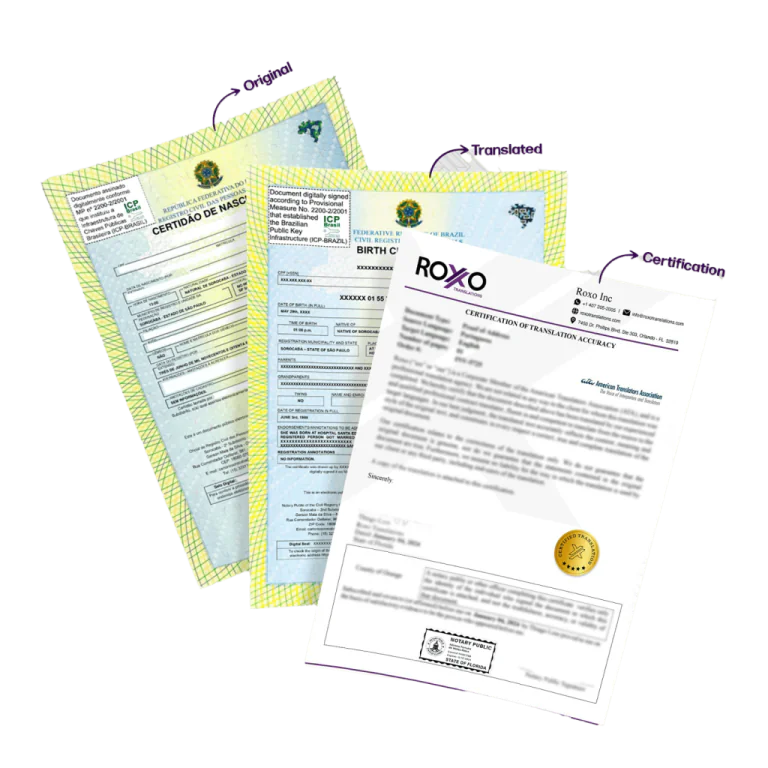
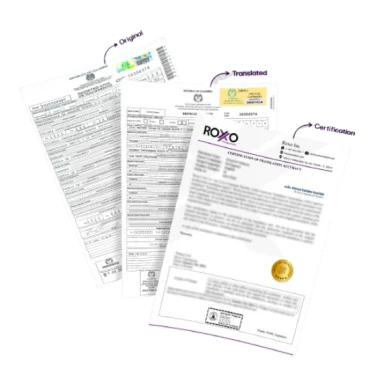
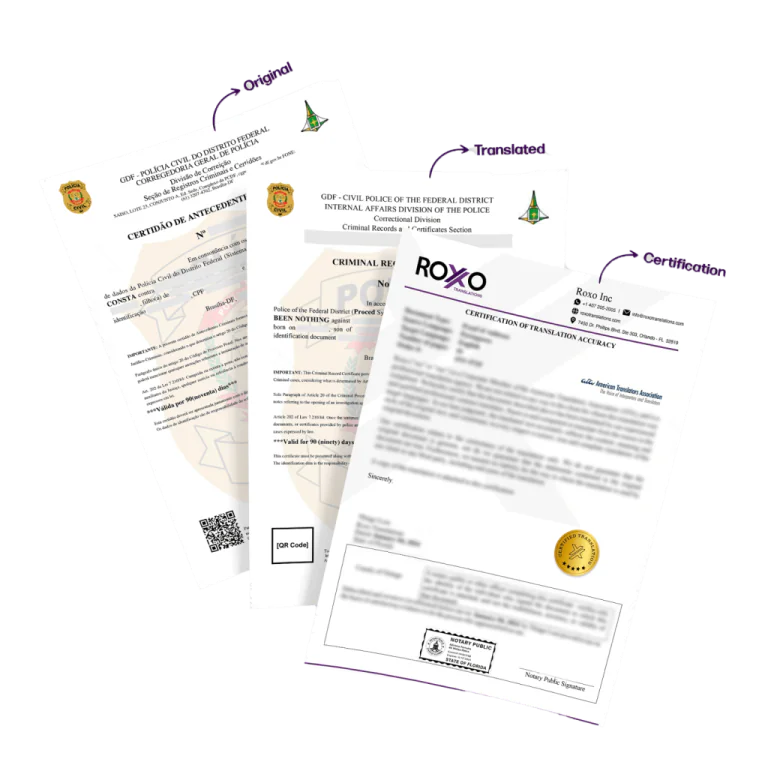
Documents we translate

Open 7 Days a Week to Serve You
Languages We Translate
Here are some of our most requested languages
 Arabic
 Chinese (Simplified)
 English (United States)
 French
 German
 Italian
 Japanese
 Korean
 Portuguese (Brazil)
 Russian
 Spanish
 Vietnamese
The 566 language pairs we translate today. Type a language to see which languages it pairs with.
Can't find your pair? Talk to us: we answer within one hour.
Certified Translation in the Main Cities of the USA
USCIS-accepted certified translations, with fast turnaround for clients across the United States.
Industry Solutions
Tailored Industry Solutions for Seamless Translations
Help Center
Turnaround, price, accepted documents and how to order: the most common questions are already answered in the Help Center, organized by topic.
Do you translate Latin baptism and marriage records and old diplomas?
Yes. We translate baptism and marriage records, parish registers, Church certificates and university diplomas written in Latin, to and from English, Italian and other languages. Handwritten records are accepted, any part that cannot be read is marked as illegible, and every name is kept as written in the original. For Italian or Portuguese citizenship, ask the consulate which language and format it accepts, and we confirm the options before quoting.
A name is spelled differently from my passport. Can you change it?
The translation reproduces names exactly as they appear in the original document. If you need another spelling, such as the one in your passport, tell us when you place your order, before we start. If we made a typo, we fix it at no cost.
Which documents do you translate?
Birth, marriage and death certificates, divorce decrees, diplomas and transcripts, driver's licenses, passports and IDs, criminal records, bank and financial statements, medical and vaccination records, contracts, affidavits and court documents, among others. Send a photo and we confirm.
Do you do sworn translations into Italian for citizenship?
Yes. Italian is one of our core languages. For Italian citizenship, the consulate or comune defines which documents to translate and whether they must be apostilled first. Send us their list and we confirm the format and build the complete order.
Can you translate between two languages other than English, such as Italian to Portuguese?
Often yes, depending on the pair and the service. For certified translation we confirm translator availability. For sworn translation into Portuguese, some pairs require a two-step route through English. We tell you the option before quoting.
Is the translation done by people or by machine?
By people. Every document is translated by a professional linguist and goes through double human review for accuracy, grammar, formatting and consistency before delivery. The translator may use support tools, such as translation memory or machine translation, as an aid, but the translator who signs or certifies the work is always responsible for it.
Check Out Our Blog!
Articles and content from the Roxo Translations team about translation, languages, and culture.
Can a family member translate your documents for USCIS?
Read More
Hukou translation: how to translate a Chinese household register for USCIS
Read More
Do you need a local certified translator? What actually matters for USCIS
Read More
Italian birth certificate translation: copia integrale, estratto or certificato?
Read More
Apostille in Sacramento: where California documents are apostilled
Read More
Apostille in Florida: who issues it, which copy is accepted and the fee
Read More
Divorce decree translation for use in the US: what is actually required
Read MoreOur Clients Trust and Recommend Us
100% Satisfied Customers