You mail a complete green card package, with your birth certificate from Colombia and a short English summary someone typed for you. Weeks later, a Request for Evidence arrives: USCIS wants a full translation with the translator's certification. Your case stops, a response deadline starts running and the date you were counting on moves back. Most translation problems in an immigration file are not about the language. They are about missing pieces that the USCIS translation requirements spell out in one sentence.
Many applicants assume each form has its own translation rule, so they search for "I-130 translation" or "N-400 translation" one by one. In fact the rule is the same for every form; what changes is which foreign documents each form asks for. This guide shows the rule, then goes form by form through the documents that usually need a certified translation for USCIS immigration, so you can translate everything once, before you file.
Key Takeaways
- Under 8 CFR 103.2(b)(3), any document containing a foreign language submitted to USCIS must come with a full English translation certified by the translator as complete and accurate, plus a certification that the translator is competent to translate from that language into English.
- The USCIS Policy Manual states that a summary of a document prepared by a translator is unacceptable.
- The current instructions for Forms I-130, I-485, I-129F, N-400, I-751, I-765 and I-589 repeat the same translation paragraph, so no form has a stricter translation rule of its own.
- The form instructions add that the certification must include the translator's signature, printed name, signature date and contact information.
- What changes from form to form is the list of documents: marriage and birth certificates for family petitions, police and court records for the green card and naturalization, identity documents for the work permit.
- Form I-589 also requires your answers on the form to be in English and an interpreter at the asylum interview if you cannot proceed in fluent English.
Contents
- What are the USCIS translation requirements?
- Does each form have its own translation rule?
- Family petitions: I-130 and I-129F
- Green card and work permit: I-485 and I-765
- After the green card: I-751 and N-400
- Asylum: why the I-589 is different
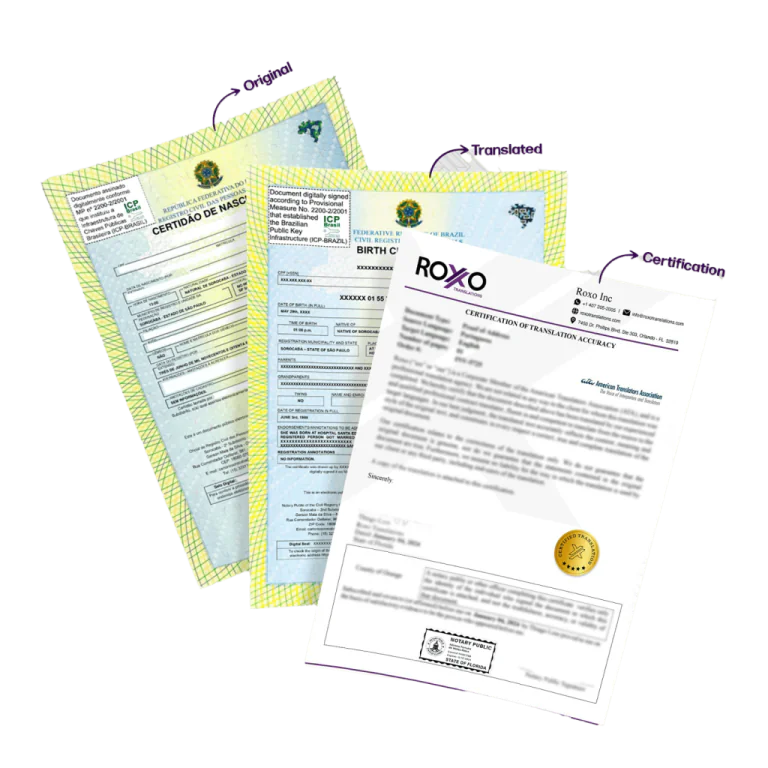
- What a compliant translation certificate includes
- Ready to order your USCIS translation?
- Frequently Asked Questions
What are the USCIS translation requirements?
The rule lives in the federal regulations, at 8 CFR 103.2(b)(3). Any document containing a foreign language submitted to USCIS must be accompanied by a full English language translation, which the translator has certified as complete and accurate, and by the translator's certification that they are competent to translate from the foreign language into English.
That gives three elements:
- A full translation. Every part of the document. In practice that includes stamps, seals and handwritten notes, because anything left out makes the translation partial.
- A certification of accuracy. The translator states that the translation is complete and accurate.
- A certification of competence. The translator states that they are competent to translate from the source language into English.
The USCIS Policy Manual, Volume 1, Part E, Chapter 6 repeats the rule and closes the most common shortcut: a summary of a document prepared by a translator is unacceptable. Its footnote explains why: USCIS needs the full translation to analyze the document, and in a 1994 rulemaking it rejected public comments asking to allow extracts or partial translations.
USCIS translation requirements fit in one line: full translation, certified as complete and accurate, by a translator who certifies competence.
Does each form have its own translation rule?
No. We read the "Translations" paragraph in the current instructions for each form below on November 6, 2026. All seven say the same thing: if you submit a document with information in a foreign language, you must also submit a full English translation, and the translator must sign a certification that the translation is complete and accurate and that they are competent to translate from the foreign language into English. The instructions add one practical detail the regulation does not spell out: the certification must include the translator's signature, printed name, the signature date and contact information.
So the translation rule is the general rule of 8 CFR 103.2(b)(3) everywhere. What each form changes is the evidence list, and therefore which of your foreign documents end up in the file.
| Form | What it is for | Foreign documents the instructions typically call for | Translation rule |
|---|---|---|---|
| I-130 | Petition for Alien Relative | Marriage certificate, divorce decrees or death certificates ending prior marriages, birth certificates showing the relationship, adoption decrees, evidence of a bona fide marriage | General rule, 8 CFR 103.2(b)(3) |
| I-129F | Petition for Alien Fiancé(e) | Divorce decree, annulment or death certificate for prior marriages, evidence of the in-person meeting and of the intent to marry | General rule |
| I-485 | Adjustment of status (green card) | Birth certificate issued by the civil authority, marriage certificate, certified police and court records | General rule |
| I-765 | Employment authorization | Identity document if you never had an EAD: passport, birth certificate with photo ID, foreign consulate visa or national ID; marriage certificate in some categories | General rule |
| I-751 | Removal of conditions on residence | Children's birth certificates, leases or mortgages, joint bank records, tax returns, insurance policies, divorce decree if filing alone | General rule |
| N-400 | Naturalization | Marriage certificate, divorce or annulment decrees, death certificates, name change documents, court records | General rule |
| I-589 | Asylum and withholding of removal | Passports, birth certificates, national ID cards, marriage certificate, children's birth or school records, corroborating evidence | General rule, plus answers in English and an interpreter at the interview |
The form decides which documents you send; 8 CFR 103.2(b)(3) decides how each foreign document must be translated.
Family petitions: what do the I-130 and I-129F need translated?
Form I-130 translation requirements
The Form I-130 instructions ask you to prove the family relationship. For a spouse, that means a copy of the marriage certificate and documents showing that every prior marriage of either spouse was legally terminated. For a parent or child, it means birth certificates showing the right names; for a father, the parents' marriage certificate as well; for adopted relatives, the adoption decree. The instructions also suggest evidence of a bona fide marriage, such as joint property, a joint lease, combined finances and the birth certificates of children born to the couple.
If any of those documents was issued abroad, it needs a full certified translation. The birth certificate is the most common one, so we keep a dedicated page for birth certificate translation.
Form I-129F translation requirements
For the K-1 fiancé(e) petition, the instructions ask for proof that any previous marriage of either party ended, through a divorce decree, an annulment or a death certificate issued by a civil authority. They also ask for evidence of the intent to marry within 90 days of entry and of an in-person meeting in the two years before filing, such as signed statements, airline tickets and passport pages. Statements written in another language, foreign decrees and stamped passport pages all fall under the same translation rule.
Green card and work permit: I-485 and I-765
Form I-485 translation requirements
The Form I-485 instructions ask for a photocopy of your birth certificate issued by the appropriate civil authority in your country of birth, and USCIS only accepts a birth certificate that lists at least one parent. Depending on the category, you also send a marriage certificate and, if you were ever arrested, charged or convicted anywhere in the world, certified police and court records.
If the birth or marriage certificate is unavailable, the instructions allow secondary evidence, such as church or school records, with an explanation of why the primary document is unavailable; if that also fails, two or more sworn affidavits from people with direct personal knowledge. Every one of those substitutes that is in a foreign language needs its own certified translation.
Form I-765 translation requirements
If you never had an Employment Authorization Document, the I-765 instructions ask for a copy of a government-issued identity document showing your picture, name and date of birth, such as a passport, a birth certificate with photo ID, a visa issued by a foreign consulate or a national ID with photo or fingerprint. Some categories also ask for a marriage certificate. A foreign national ID card is short, but it still needs a complete translation of every side that carries text.
After the green card: I-751 and N-400
Form I-751 translation requirements
To remove the conditions on a two-year green card, the I-751 instructions list evidence of a marriage entered in good faith: birth certificates of children born during the marriage, leases or mortgages showing joint residence, joint bank accounts with transaction history, joint tax returns, insurance policies and affidavits from people who know the couple. If you file alone because the marriage ended, you also send the final divorce decree. Bank records and leases from abroad are long documents, so count pages early.
Form N-400 translation requirements
The Form N-400 instructions ask for documents when your name changed, such as a marriage certificate, divorce decree or court order. If you apply based on marriage to a U.S. citizen, you send the current marriage certificate and any divorce decree, annulment decree or death certificate ending prior marriages. If you have any criminal history, you send the related records, and the instructions say you may send photocopies with the application but must bring originals or court-certified copies to the interview. Foreign court records are often the hardest documents to translate, because of legal terms and handwritten annotations.
Asylum: why the I-589 is different
The I-589 instructions contain the same translation paragraph as the other forms, so every foreign-language document attached to an asylum application needs a full certified translation. Two extra rules make this form different:
- Your answers on Form I-589 must be completed in English.
- If you cannot proceed with the asylum interview in fluent English, you must bring, at no expense to USCIS, a competent interpreter fluent in English and in a language you speak fluently. The interpreter must be at least 18, and cannot be your attorney or representative of record, a witness testifying for you, or a representative or employee of your country.
The instructions also ask for copies of all passports, cover to cover, and recommend submitting other identity documents, such as a birth certificate or national ID. The instructions also ask for reasonably available corroborative evidence, and documents from your country supporting the claim are often in a foreign language, so they must be translated in full.
For asylum, the translation of the evidence and the interpreter at the interview are two separate obligations.
What does a compliant translation certificate include?
Putting the regulation and the form instructions together, a translation ready for any of the forms above includes:
| Element | Source |
|---|---|
| Full English translation of every part of the document | 8 CFR 103.2(b)(3); Policy Manual (summaries unacceptable) |
| Statement that the translation is complete and accurate | 8 CFR 103.2(b)(3) |
| Statement that the translator is competent to translate from the foreign language into English | 8 CFR 103.2(b)(3) |
| Translator's signature and printed name | Form instructions |
| Date of the signature | Form instructions |
| Translator's contact information | Form instructions |
Two things are not on that list. The regulation does not mention notarization, and it does not require an apostille on the translation; we explain the second point in does USCIS require an apostille. Under 8 CFR 103.2(b)(4) and (b)(5), you submit originals or photocopies as each form's instructions say, and USCIS may request an original at any time.
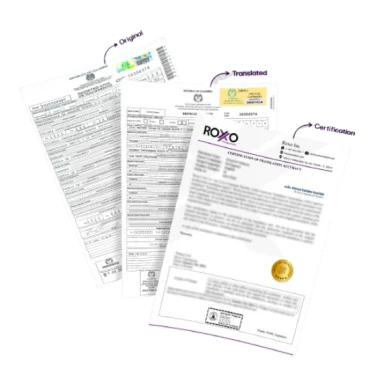
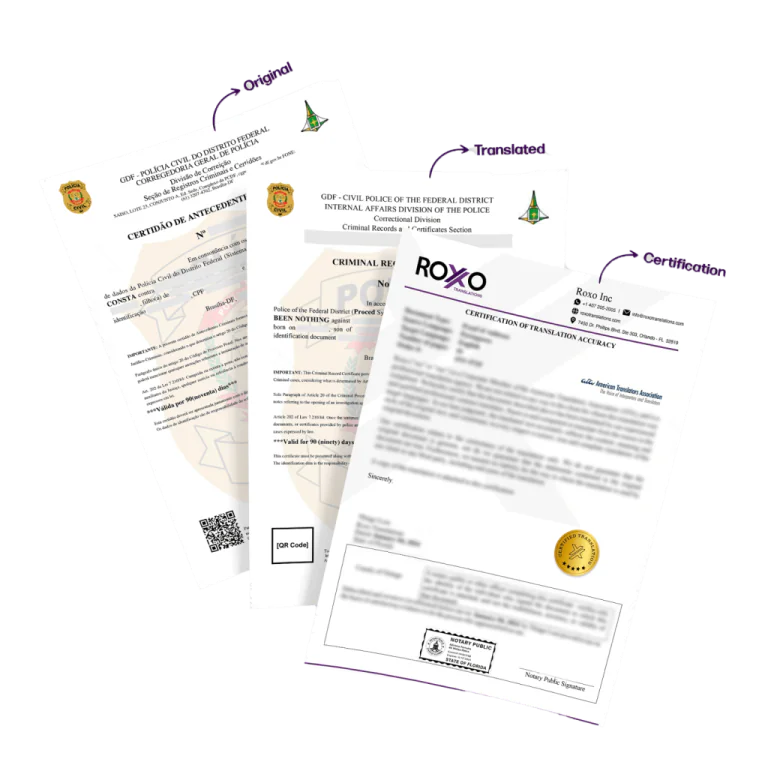
At Roxo Translations, our certified translations come in the format USCIS accepts, are priced per page (see the pricing page) and can be delivered in 24 hours. Translators certified by the ATA translate, and a second translator reviews every document: double human review, 100% human. The process is 100% online, our clients rate us 5.0 on Google with more than 2,000 reviews, and our team answers on WhatsApp 7 days a week. For more answers about certified translation in the US, visit our Help Center on certified translation in the US.
Ready to order your USCIS translation?
Whatever the form, the translation rule is the same. Upload your birth certificates, marriage records, decrees and police records, see the price and the deadline before you pay, and receive full certified translations ready to file.
Frequently Asked Questions
Does USCIS require a certified translation for every foreign document?
Yes. Under 8 CFR 103.2(b)(3), any document containing a foreign language submitted to USCIS must come with a full English translation and the translator's certification of accuracy and competence.
Do the I-130, I-485 and N-400 have different translation requirements?
No. Their current instructions repeat the same translation paragraph. They differ only in which documents they ask for.
Is a summary translation acceptable to USCIS?
No. The USCIS Policy Manual states that a summary of a document prepared by a translator is unacceptable. The translation must cover the whole document.
What must the translator's certification include?
A statement that the translation is complete and accurate, a statement that the translator is competent to translate from the foreign language into English, and, per the form instructions, the translator's signature, printed name, signature date and contact information.
Does a USCIS translation need to be notarized?
The regulation does not require notarization. It requires the translator's certification of accuracy and competence.
Do I send the original foreign document to USCIS?
Generally you send what each form's instructions ask for, often a photocopy, with the translation. USCIS may request the original at any time under 8 CFR 103.2(b)(5).
What if my birth certificate is unavailable?
The I-485 instructions allow secondary evidence, such as church or school records, with an explanation, and then affidavits if needed. Any of these in a foreign language needs a certified translation.
Can I reuse the same translation for more than one form?
The translation rule is identical across these forms, so a compliant certified translation of a document meets the requirement wherever that document is filed. Send a copy with each filing that asks for the document.
Related Topics: Marriage certificate translation | Divorce certificate translation | Passport translation | Notarized translation
Related Article: What is certified translation and what it includes
















 Emails
 Court Documents
 Criminal Record
 Resume
 Adoption Documents
 Spanish Medical Records
 ID Card
 Employee Handbook
 Birth Certificate
 Driving License
 Sworn Affidavits
 Business License
 Certificates
 Brochures

 Arabic
 Chinese (Simplified)
 Dutch
 French
 German
 Italian
 Japanese
 Korean
 Portuguese (Brazil)
 Russian
 Spanish
 Vietnamese