








 Driving License
 Birth Certificate
 Spanish Transcript
 Court Documents
 Marriage Certificate
 Death Certificates
 Vaccination Record
 WhatsApp Messages
 Financial Statement
 Employee Handbook
 Spanish Medical Records
 Legal Contract
 Patent Application
 ID Card
















Slovenian Translation Services
Roxo Translations offers Slovenian translation services to and from English, for documents from Slovenia, from the Slovenian communities in Italy, Austria and Hungary and from the families abroad. Every translation is done by a human translator, native in the target language, and reviewed by a second one, never by machine translation.
Send a photo or scan of the document, see the price and the deadline instantly, and receive the translation as a PDF. For the United States it comes certified and accepted by USCIS, with the signed statement and optional notarization.
- Slovenian to English and English to Slovenian
- Certified for USCIS, with optional notarization
- Instant online quote and fast delivery
- 2,199 reviewsExcellent5.0
- 125,378documents translated
- 62,595,638words translated
Where Slovenian is spoken and where your translation is accepted
Slovenian is the official language of Slovenia and, since 2004, an official language of the European Union. It is also a recognized minority language in Italy, in the region of Friuli Venezia Giulia, in Austria, in Carinthia and Styria, and in Hungary, along the Rába river, and it has more than 2 million speakers. Emigration took Slovenian to the United States, above all to Cleveland, Ohio, and to Argentina, Canada, Australia and Germany, where many families still need Slovenian records. The destination decides the type of translation.
| Where | What you need |
|---|---|
| United States: USCIS, courts, universities and employers | Certified translation into English, with the signed statement of accuracy and optional notarization |
| Brazil: notary offices, universities and public agencies | Sworn translation into Portuguese, signed by a public sworn translator and valid nationwide. For Slovenian, we confirm it in the quote |
| Slovenia, Italy, Austria and other countries | Ask the receiving authority which format it accepts: we tell you the options before quoting, including the Hague apostille when it applies |
| Slovenian consulates, citizenship and immigration processes | The translation into the language the authority asks for, with the apostille on the original when it is required |
Slovenian language pairs we translate
Today our Slovenian pair is with English, in both directions: Slovenian to English and English to Slovenian.

Need a pair that is not on the list? Talk to us: we answer within one hour, 7 days a week.
Slovenian translation services for Slovenia, Italy and Austria
Slovenian has many dialects, grouped in seven regional groups, but documents are written in the standard language, and records from Slovenia follow their own formats. A good translation follows the language of the original, keeps every letter of the names and reads naturally to whoever receives it.
- Letters: Slovenian uses a Latin alphabet of 25 letters, with č, š and ž and without q, w, x and y, and unlike Croatian it has no ć or đ. American documents often drop the marks, so Zupančič becomes Zupancic. The translation keeps every name exactly as in the original, so tell us the form used in your US documents when you order.
- Slovenian, Italian and Hungarian: in the bilingual towns of the coast, such as Koper and Piran, Italian is also official, and around Lendava, Hungarian, so some documents come in two languages and the translation covers both. Slovenian (slovenščina) is not the same as the language of Slovakia, although the names look alike, so tell us the country that issued the document.
- Names: a surname does not change with gender, so Janez Novak and Marija Novak share the same form. In running text names change their ending with grammatical case, so Janez Novak can appear as Janeza Novaka, and Slovenian even keeps a special form for exactly two people or things, the dual. The translation keeps the name as it is written in the identity fields of the original.
- Dates and numbers: dates use periods, often with spaces, so 3. 10. 2026 or 3. oktober 2026 is October 3, 2026, and some months have their own spelling, such as marec for March and avgust for August. Decimals use a comma and thousands a period, so 1.500,00 is one thousand five hundred.
- Documents from Slovenia: the birth certificate (rojstni list), the marriage certificate (poročni list), the certificate of citizenship (potrdilo o državljanstvu) and the ID card (osebna izkaznica), which carries the 13-digit personal registration number (EMŠO). The translation reproduces every stamp, seal and note.

The history of the Slovenian language
Slovenian is a South Slavic language, brought to the Eastern Alps by the Slavs who settled there in the 6th century. Its oldest record is the Freising manuscripts (Brižinski spomeniki), written around the year 1000 and kept today in Munich. They are the oldest known text in a Slavic language written in the Latin alphabet.
In 1550 Primož Trubar published the first printed books in Slovenian, a catechism and a primer, the Catechismus and the Abecedarium. In 1584 Jurij Dalmatin published the whole Bible in Slovenian, and Adam Bohorič published the first grammar of the language. In the 19th century the poet France Prešeren gave Slovenian its great literature, and in the 1840s the old spelling gave way to the Latin alphabet with č, š and ž that is used today.
In Yugoslavia, Slovenian stayed the language of Slovenia, used in its schools, courts and press. After Slovenia became independent on June 25, 1991, Slovenian was confirmed as its official language, and a stanza of Prešeren’s poem Zdravljica became the national anthem. On May 1, 2004, when Slovenia joined the European Union, Slovenian became an official language of the Union. Today it has more than 2 million speakers, in Slovenia, in the neighboring countries and in the communities abroad.

We also translate other languages
How to translate your document 100% online
-

Upload your documents
-
Choose the service
-
Human translation
-

First proofreading
-
Second proofreading
-

Fast delivery
-

Your satisfaction
We Translate All Types of Documents, Respecting the Original Format
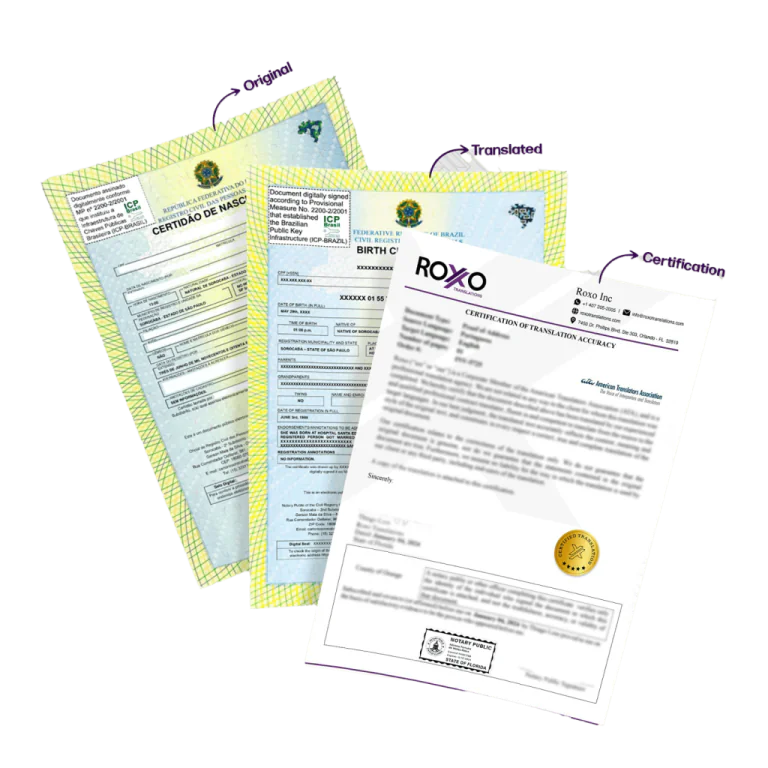
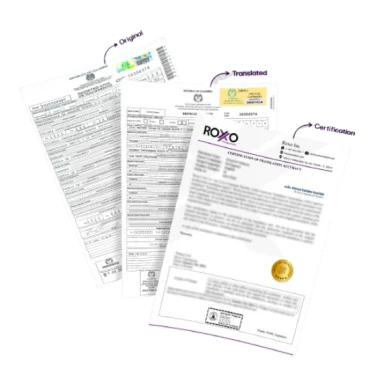
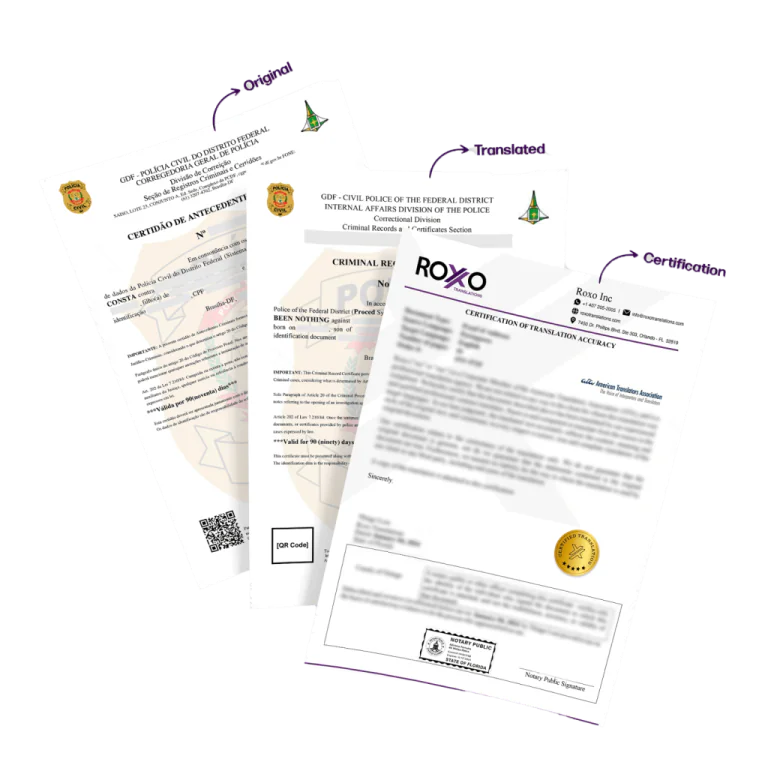
Documents we translate
Open 7 Days a Week to Serve You
Languages We Translate
Here are some of our most requested languages
 Arabic
 Chinese (Simplified)
 English (United States)
 French
 German
 Italian
 Japanese
 Korean
 Portuguese (Brazil)
 Russian
 Spanish
 Vietnamese
The 566 language pairs we translate today. Type a language to see which languages it pairs with.
Can't find your pair? Talk to us: we answer within one hour.
Certified Translation in the Main Cities of the USA
USCIS-accepted certified translations, with fast turnaround for clients across the United States.
Industry Solutions
Tailored Industry Solutions for Seamless Translations
Help Center
Turnaround, price, accepted documents and how to order: the most common questions are already answered in the Help Center, organized by topic.
Do you translate Slovenian from Slovenia and from the Slovenian communities in Italy and Austria?
Yes. We translate documents from Slovenia and from the Slovenian communities in Italy, Austria and Hungary, such as the birth certificate (rojstni list), the certificate of citizenship and ID cards. Today our Slovenian pair is with English, in both directions: Slovenian to English and English to Slovenian. If you need a sworn translation into Portuguese for Brazil, we confirm it in the quote.
A name is spelled differently from my passport. Can you change it?
The translation reproduces names exactly as they appear in the original document. If you need another spelling, such as the one in your passport, tell us when you place your order, before we start. If we made a typo, we fix it at no cost.
What is a certified translation?
A certified translation is a complete translation signed by a qualified professional, with a statement attesting that it is accurate and complete. In the United States it is the format required by USCIS, courts, universities and most official institutions.
Which documents do you translate?
Birth, marriage and death certificates, divorce decrees, diplomas and transcripts, driver's licenses, passports and IDs, criminal records, bank and financial statements, medical and vaccination records, contracts, affidavits and court documents, among others. Send a photo and we confirm.
Is the translation done by people or by machine?
By people. Every document is translated by a professional linguist and goes through double human review for accuracy, grammar, formatting and consistency before delivery. The translator may use support tools, such as translation memory or machine translation, as an aid, but the translator who signs or certifies the work is always responsible for it.
Which languages do you translate?
Our core languages are Portuguese, Spanish, English, Italian and French, and we work with many more, from Arabic and Chinese to German, Japanese and Russian. Tell us the language pair and we confirm availability before quoting.
Check Out Our Blog!
Articles and content from the Roxo Translations team about translation, languages, and culture.
Vietnamese birth certificate translation: names, accents and the Giấy khai sinh
Read More
Apostille in Texas: who issues it and which copy is accepted
Read More
Can a family member translate your documents for USCIS?
Read More
Hukou translation: how to translate a Chinese household register for USCIS
Read More
Do you need a local certified translator? What actually matters for USCIS
Read More
Italian birth certificate translation: copia integrale, estratto or certificato?
Read More
Apostille in Sacramento: where California documents are apostilled
Read MoreOur Clients Trust and Recommend Us
100% Satisfied Customers