You have counted the days, booked the Life in the UK Test and set the fee aside. Then, a few weeks before you apply, you notice that your marriage certificate, your child's birth certificate or the degree you are using for English is in Portuguese, Polish or Arabic. Gathering the documents required for indefinite leave to remain is usually the slowest part of settlement, and papers issued in another language are where most of the last-minute stress comes from.
The Immigration Rules are strict about this. A document that is not in English or Welsh has to travel with a full translation that meets a fixed list of points, the kind of certified translation in the UK that the Home Office asks for. If a specified document is missing or does not meet the rules, the requirement it was meant to prove is treated as not met. With a decision usually taking up to 6 months, and no travel abroad allowed while you wait, a refusal costs time you cannot get back.
Key Takeaways
- Most ILR applicants aged 18 to 64 must pass the Life in the UK Test, and applicants on family and long residence routes must also prove their English, usually at B1 level or higher in speaking and listening.
- Any document that is not in English or Welsh must be sent in the original language together with a full translation that the Home Office can verify independently, under paragraph 39B of the Immigration Rules.
- The translation must be dated and include a confirmation that it is accurate, the full name and signature of the translator or of an authorised official of the translation company, and their contact details.
- For leave to remain and indefinite leave to remain, the rules add one more point: certification by a qualified translator, with details of the translator's or company's credentials.
- Documents issued in the UK in English, such as payslips, P60s and council tax bills, need no translation; translation is usually needed for certificates and records issued abroad.
- The rules set what the translation must contain, not where the translator lives, so a qualified translator outside the UK can certify your documents.
Contents
- What documents are required for indefinite leave to remain?
- Which documents does each ILR route ask for?
- Which foreign documents need a certified translation for ILR?
- What must a certified translation for ILR include?
- Who can translate your ILR documents?
- How do you put the ILR document pack together without delays?
- Ready to order your certified translation for ILR?
- Frequently Asked Questions
What documents are required for indefinite leave to remain?
There is no single list. GOV.UK explains that the online form tells you which documents to provide, depending on your route, but most applications are built from the same blocks.
The core documents for most ILR applications
- Identity and status: your current passport or travel document and, for the long residence route, every passport you held during your time in the UK, plus your biometric residence permit (it can be expired) or a share code for your eVisa.
- Life in the UK Test: a pass, if you are aged 18 to 64. You do not need to take it again if you passed it before.
- English language: a recognised English test at B1 level or higher, or a degree taught or researched in English. A degree from a university outside the UK also needs an assessment from Ecctis confirming it was taught in English.
- Evidence for your route: salary and sponsor confirmation for work routes, relationship and income evidence for partners, or proof of 10 years of lawful continuous residence.
- Documents for your children, if you include them: evidence of the relationship and, for children over 16, proof of where they live, dated no more than a month before you apply.
The official overview is on the GOV.UK page Check if you can get indefinite leave to remain, which links to the guide for each route.
The ILR form tells you which documents to upload, but it does not translate them for you: anything not in English or Welsh needs a translation alongside it.
Which documents does each ILR route ask for?
The table below summarises the four routes most applicants use, as described on GOV.UK in November 2026. Settlement rules change, so check the guide for your route on the day you apply.
| Route | Time in the UK | Main route-specific evidence | Life in the UK and English |
|---|---|---|---|
| Skilled Worker, Health and Care Worker or T2 | 5 years, with no more than 180 days outside the UK in any 12 months | Salary that meets the requirements and a document from your sponsor confirming you are still needed | Life in the UK Test; no new English evidence, because you proved it for the visa |
| Partner on a family visa (5 year route) | 5 continuous years as a partner, not counting time as a fiancé(e) | Proof of combined income, proof you have lived together since your last visa, proof the relationship is genuine | Life in the UK Test and English at B1 in speaking and listening |
| Partner as a dependant on a work visa | Usually 5 years living with your partner as their dependant | Proof of the relationship and of enough income without public funds | Life in the UK Test and English |
| Long residence | 10 years of lawful continuous residence, with up to 180 days abroad in any 12 months | All passports held during your time in the UK, BRP or eVisa | Life in the UK Test and English |
Partners on the family route carry the heaviest evidence load; Skilled Workers the lightest, since most of their evidence comes from a UK employer in English.
The longer the evidence list on your route, the more likely it is that some of it was issued abroad and needs translating.
Which foreign documents need a certified translation for ILR?
The rule is simple to state: under paragraph 39B(f) of the Immigration Rules, Part 1, any specified document that is not in English or Welsh must be sent in the original language together with a full translation. The GOV.UK guide for the long residence route says the same in plain words: provide a certified translation of any document that is not in English or Welsh.
In practice, these are the documents that most often need translating for indefinite leave to remain:
| Document | When it is usually needed | Translation needed? |
|---|---|---|
| Marriage or civil partnership certificate issued abroad | Partner routes, or a partner included as a dependant | Yes, if it is not in English or Welsh |
| Divorce certificate or decree issued abroad | Showing that a previous marriage or partnership has ended | Yes, if it is not in English or Welsh |
| Children's birth certificates issued abroad | Including children or proving that you are their parent | Yes, if they are not in English or Welsh |
| Degree certificate from a university outside the UK | Proving English through a degree taught in English, together with the Ecctis assessment | Yes, if the certificate is not in English |
| Bank statements, payslips or employer letters from abroad | Income from work overseas or savings held abroad, on routes with a financial requirement | Yes, if they are not in English |
| UK payslips, P60s, tenancy agreements, council tax and utility bills | Income and address evidence | No, they are already in English |
| Life in the UK Test pass and English test result | Knowledge of language and life | No |
Two details catch people out. First, a full translation means every part of the document: stamps, seals, handwritten notes, marginal annotations and the back of the page. Second, you still send the original-language version. The rules accept copies of specified documents, so a clear scan of the original sits next to its translation.
If a document was issued in another language and you are relying on it, translate it in full: partial translations and summaries do not meet paragraph 39B.
What must a certified translation for ILR include?
Paragraph 39B(f) of the Immigration Rules, and the matching paragraph 1(j) of Appendix FM-SE for family routes, say the translation must be one that a caseworker can verify independently. It must be dated and include:
- Confirmation that it is an accurate translation of the original document.
- The full name and signature of the translator or of an authorised official of the translation company.
- The contact details of the translator or of the translation company.
- The date of the translation.
- For leave to remain and indefinite leave to remain, certification by a qualified translator and details of the translator's or company's credentials.
The fifth point is the one that matters most for ILR. A translation that was good enough for an entry clearance application made from abroad may not carry the translator's credentials, because the rules only add that point for applications made in the UK. Before you reuse an old translation, check that it states who translated it and what their credentials are.
Paragraph 39B(e) adds a related requirement: specified documents must contain, or you must provide, full contact details so each document can be verified. A translation with a name but no way to contact the translator or company falls short.
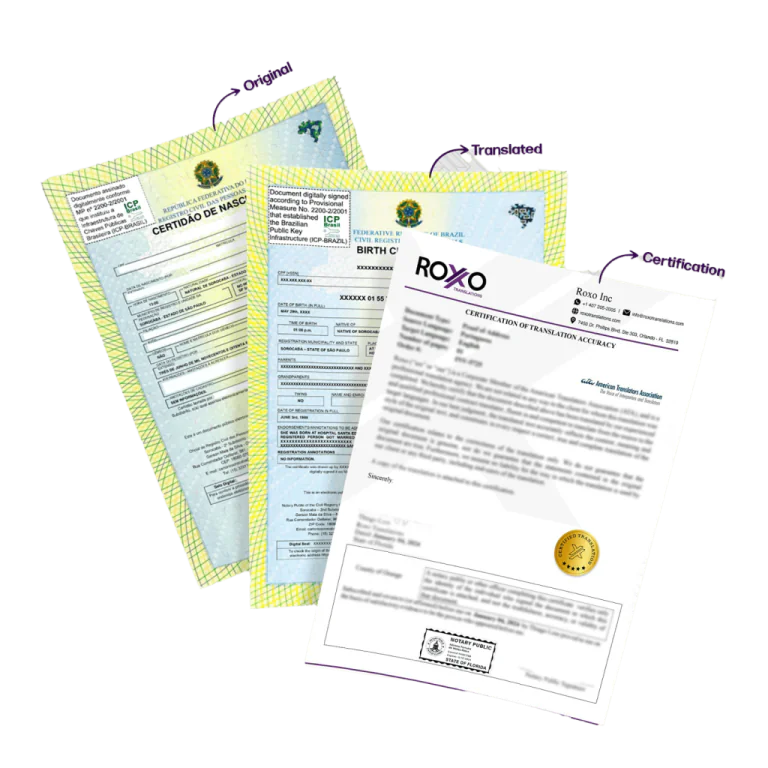
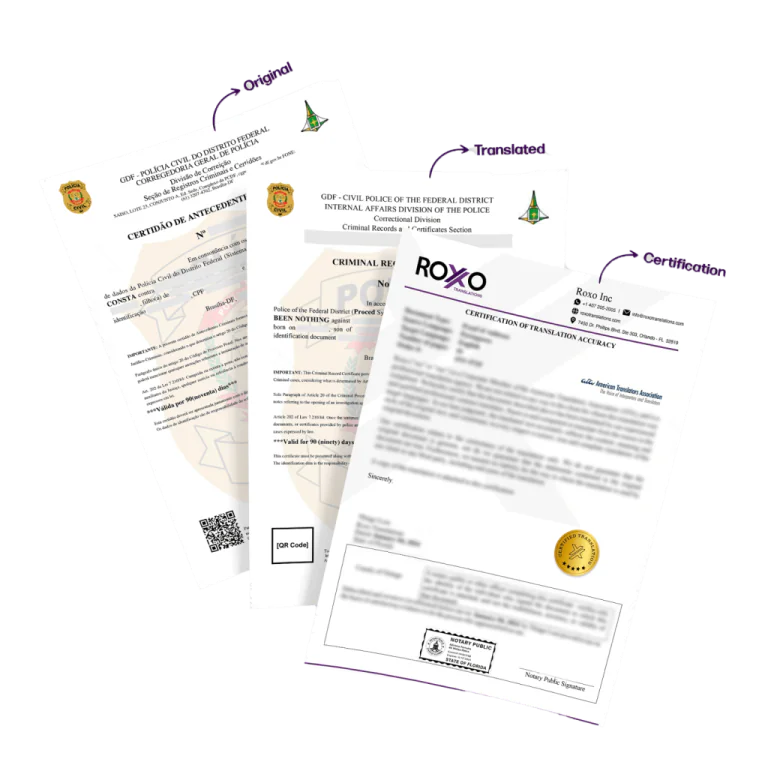
For indefinite leave to remain, a certified translation has five parts: accuracy statement, date, name and signature, contact details, and the qualified translator's credentials.
Who can translate your ILR documents?
The rules describe the translation, not a list of approved people. That has three practical consequences.
Not you, and not a relative
A translation you or a family member produce cannot be verified independently in any meaningful way, and it cannot show the credentials of a qualified translator. Even if you speak both languages fluently, use a professional translator or a translation company.
No official register of translators
The Home Office does not approve, accredit or list translators, so there is no such thing as a "Home Office approved translator". What counts is a professional translator who can show a qualification and a certificate that meets the rules. If you want to understand what that looks like, our page on the certified translator in the UK explains what the Home Office means by a qualified translator.
The translator can be anywhere
Nothing in paragraph 39B requires a translator based in the UK, and the rules do not ask for the translation to be notarised. A certificate that contains all five points, signed by a qualified translator, meets the requirement wherever it was produced.
Choose the translator by the certificate they issue, not by a claim of official approval that does not exist in the UK.
How do you put the ILR document pack together without delays?
Most delays come from documents discovered late. This order of work keeps the pack moving:
- Confirm your route and your date. On the work and family routes, the earliest you can apply is 28 days before you complete the qualifying period. Applying earlier can lead to refusal.
- List every document that is not in English or Welsh. Include the back of each page, stamps and annotations, and any foreign document that explains a change of name.
- Send legible copies for translation early. A clear phone photo of every page, front and back, is usually enough to start; our Help Center explains how to send your documents and order a translation.
- Check that names match. Tell the translator how names appear in your passport, so the spelling is the same across every document.
- Leave date-sensitive evidence to the end. On family routes, evidence for a period ending on the application date must be dated no earlier than 28 days before you apply, and address documents for children over 16 no more than a month old.
- Upload each translation next to its original. You can upload documents in the online service or have them scanned at your UK Visa and Citizenship Application Services appointment.
- Stay in the UK until you have a decision. Travelling outside the UK, Ireland, the Channel Islands or the Isle of Man withdraws the application.
Translate stable documents such as certificates first, and recent documents such as bank statements last, so nothing is out of date on the day you apply.
Ready to order your certified translation for ILR?
Roxo Translations translates marriage, birth and divorce certificates, degree certificates and financial records for UK settlement applications, with a signed certificate that covers every point paragraph 39B lists, including the date, our contact details and the translator's credentials. Every translation is 100% human, with double review, and the whole process is 100% online: upload your documents and you see the price and the delivery date before you pay. We are rated 5.0 on Google, with more than 2,000 reviews, and our team answers on WhatsApp 7 days a week.
Frequently Asked Questions
Do UK-issued documents need translating for indefinite leave to remain?
No. The translation rule only applies to documents that are not in English or Welsh. Payslips, P60s, bank statements, tenancy agreements and council tax bills issued in the UK in English are sent as they are.
Can I translate my own documents for an ILR application?
No. The Home Office must be able to verify the translation independently, and for indefinite leave to remain it must be certified by a qualified translator with their credentials. You and your relatives cannot meet that standard, even if you are bilingual.
Does an ILR translation need to be notarised?
No. Paragraph 39B of the Immigration Rules lists what a translation must contain, and notarisation is not on the list. A signed certificate with the accuracy statement, date, name, contact details and credentials is what the rules ask for.
Does the translator have to be based in the UK?
No. The rules set out the content of the translation, not the translator's location. A qualified translator abroad can certify a translation for indefinite leave to remain, as long as the certificate includes every required point.
What does "qualified translator" mean for ILR?
The Immigration Rules ask for certification by a qualified translator and details of their credentials, but they do not define the qualification. In practice, it is a professional translator who can show credentials, such as a translation qualification or membership of a professional association.
Do I send the original document or a copy with the translation?
The rules accept originals or copies of specified documents. You provide the document in the original language together with its full translation, usually by uploading both in the online service or having them scanned at your appointment.
Related Topics: Translation services in the UK | Certified translator in London | Certified translator in Manchester | Certified translator in Birmingham
Related Article: What is certified translation: what it includes










 Power of Attorney
 Spanish Birth Certificate
 Name Change
 Emails
 Employee Handbook
 Sworn Affidavits
 Driving License
 Court Documents
 ID Card
 Business License
 Spanish Transcript
 Legal Contract
 Adoption Documents
 Diploma

 Arabic
 Chinese (Simplified)
 Dutch
 French
 German
 Italian
 Japanese
 Polish
 Russian
 Spanish
 Turkish
 Vietnamese