If you’re preparing an immigration application in the United States, you already know that paperwork isn’t just paperwork, it’s your timeline, your eligibility, and often your peace of mind. One of the most common causes of avoidable delays is also one of the most underestimated: document translation.
USCIS requires that any document containing foreign language text be submitted with a full English translation and a certification from the translator stating the translation is complete and accurate. When translations are incomplete, inconsistent, or poorly formatted, applicants can face delays, additional evidence requests (RFEs), or the headache of resubmitting documents under pressure.
This guide explains what USCIS expects, which documents typically require certified translation, the mistakes that slow cases down, and best practices to help you submit confidently, without cutting corners.
Contents
- What is a “Certified Translation” for USCIS?
- When do you need certified translation?
- What “complete translation” really means (and what people miss)
- Top mistakes that cause delays (and how to avoid them)
- Best practices: how to prepare documents for fast, clean translation
- Why professional certified translation matters for immigration
- ConclusãoHow Roxo Translations supports your immigration process
- Conclusion
What is a “Certified Translation” for USCIS?
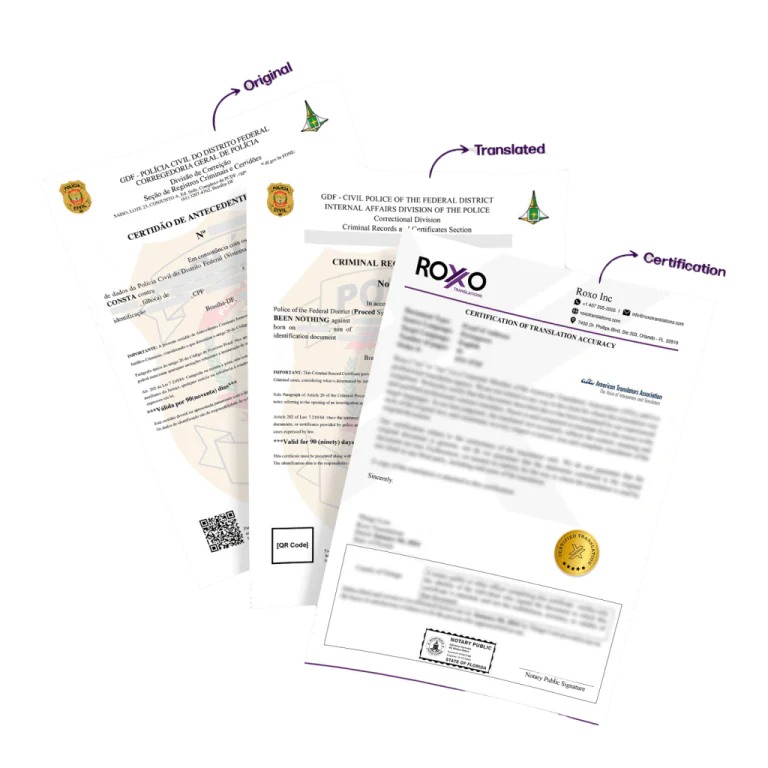
A certified translation for USCIS is not a special “stamp” from the government. Instead, it is:
-
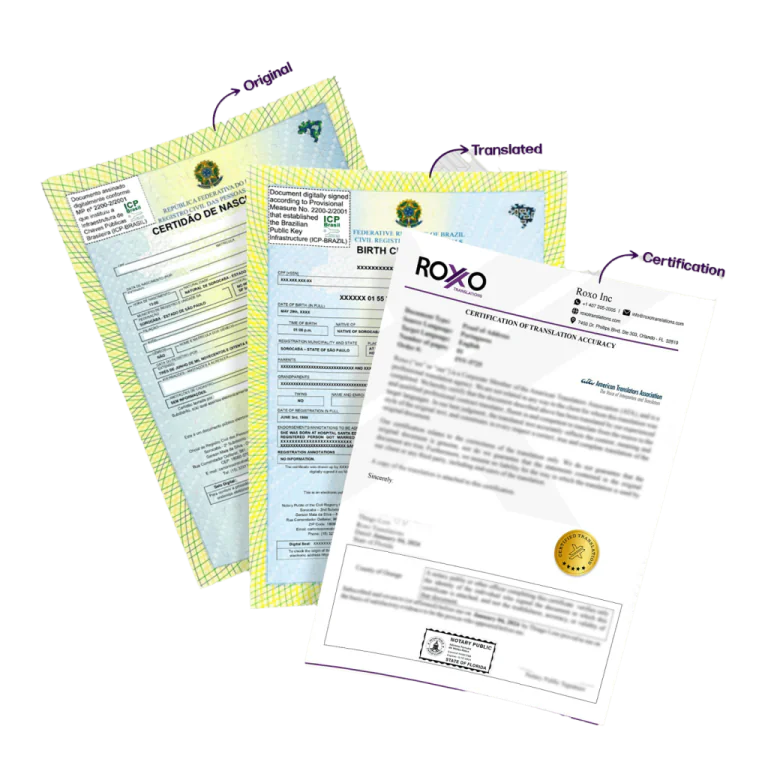
A complete English translation of the foreign-language document, and
-
A signed certification statement (also called a Certificate of Translation Accuracy) confirming:
-
The translation is accurate and complete, and
-
The translator is competent to translate from the source language into English.
USCIS is looking for translations that are:
-
Complete (every item, seal, stamp, notation, back page, and annotation included)
-
Accurate (names, dates, places, numbers, official terms)
-
Consistent across documents (same spelling of names, same date format logic, same terminology)
-
Clear and readable (so an officer can quickly compare original and translation)
When do you need certified translation?
As a general rule, any time you submit a document with non-English text, you must include:
-
A copy of the original document, and
-
A full English translation with certification.
This frequently applies to:
-
Family-based petitions
-
Adjustment of status
-
Green card applications
-
Naturalization filings
-
Employment-based filings (when civil documents are required)
-
Any case involving identity, relationship, civil status, education, or legal history evidence
Even if your document includes some English, if it still contains foreign-language text, you still need a certified translation for the non-English portions.
Common immigration documents that require certified translation
Here are documents that often appear in USCIS filings:
Civil documents
Birth certificate
Marriage certificate
Divorce decree / dissolution records
Death certificate (when applicable)
Name change orders
Adoption records
Identity and residency
National ID documents
Driver’s license (when requested or used as evidence)
Household registration / family registry (common in some countries)
Education and employment
Diplomas and transcripts
Professional licenses
Employment letters (if not in English)
Legal and government records
Police certificates / background checks
Court records and judgments
Military records (if required)
Important: USCIS can request additional documentation depending on your case. If you’re unsure, it’s safer to have certified translation ready, especially for documents you expect to be reviewed.
What “complete translation” really means (and what people miss)
Many applicants assume only the “main text” matters. USCIS officers often look for details in areas people skip. A complete translation should include:
Stamps and seals (or a note describing them)
Handwritten notes
Marginal notes
Notary statements
Registration numbers
Dates in multiple places (issue date vs. event date)
Back-page notes or endorsements
Apostilles (if attached)
If a stamp is partially illegible, a professional translation typically notes that fact clearly rather than ignoring it.
Top mistakes that cause delays (and how to avoid them)
1) Using machine translation for official documents
Machine translation tools can be helpful for casual content, but for USCIS documents they can:
mistranslate legal terms,
drop formatting cues,
misunderstand civil registry language,
produce inconsistent names and places.
Fix: Use a professional certified translation service with quality checks.
2) Translating only parts of the document
Skipping stamps, notes, or back pages can trigger doubts about completeness.
Fix: Always request full translation, including annotations and non-text elements described in brackets when necessary.
3) Inconsistent spelling of names
A single applicant might appear as:
“João da Silva” on one document,
“Joao Silva” on another,
“Joao da Silva” on a third.
Inconsistencies can raise questions, especially if your case depends on matching identity across documents.
Fix: Standardize names carefully and keep a consistent approach. A professional translator can also add clarifying notes when appropriate.
4) Date format confusion
Many countries use DD/MM/YYYY, while the U.S. typically uses MM/DD/YYYY. If dates are swapped incorrectly, it can look like contradictory evidence.
Fix: Translate dates carefully and keep formatting consistent. When needed, include the month spelled out (e.g., “12 March 2019”) to prevent ambiguity.
5) Missing or weak certification statement
A USCIS-appropriate certification should clearly confirm accuracy, completeness, and translator competence.
Fix: Ensure your translation includes a proper signed certification statement.
Best practices: how to prepare documents for fast, clean translation
Use this checklist to reduce the chance of an RFE related to translations:
Copy of the original document included
Full English translation included
Certification statement included and signed
Names match across documents
Dates are accurate and unambiguous
Stamps/seals/notes are translated or described
All pages (front/back) are accounted for
This takes two minutes, and can save weeks of waiting.
Why professional certified translation matters for immigration
Immigration applications are high-stakes. The goal isn’t just “translate it”, the goal is to help your evidence be:
easy to verify,
consistent,
credible,
ready to submit.
A good certified translation can reduce:
rework,
stress,
delays,
and documentation confusion.
ConclusãoHow Roxo Translations supports your immigration process
Roxo Translations provides USCIS-accepted certified translations designed for immigration filings:
-
Accurate and complete translations
-
Professional formatting that mirrors the original document
-
Consistency checks (names/dates)
-
Fast delivery without sacrificing quality
-
Support in multiple languages (as needed)
If you’re preparing an immigration package, the safest move is to treat translation as part of your submission strategy, not an afterthought.
Conclusion
USCIS certified translation requirements are straightforward, but the details are where most people get stuck. Full translation, correct certification, and consistent formatting can prevent avoidable delays and help your case move forward smoothly.
If you want to submit with confidence, make sure your translations are complete, certified, and ready for USCIS review.
Related topics: USCIS certified translation | certified translation for immigration | immigration document translation | birth certificate translation for USCIS | certified translator near me
Related article: Certified Translations for USCIS: Everything You Need to Know













 Birth Certificate
  Marriage Certificate
  Divorce Documents
  Academic Transcripts
  Medical Records
  Diploma
  Legal Contract
  Rental Contract
  Patent Application
  Statement
  Death Certificates
  Financial Statement
  Sworn Affidavits
  Driving License
  Vaccination Record
 Arabic
  Chinese
  French
  German
  Italian
  Japanese
  Korean
  Portuguese
  Russian
  Spanish
  Vietnamese