









 Passport
 Certificates
 Criminal Record
 Birth Certificate
 Medical Records
 Resume
 WhatsApp Messages
 Sworn Affidavits
 Name Change
 Marriage Certificate
 Vaccination Record
 Press Release
 Death Certificates
 Divorce Documents
 ID Card





















Tagalog Translation Services
Roxo Translations offers Tagalog translation services for documents from the Philippines and from the Filipino communities of the United States, Canada, the Gulf countries and Europe, to and from English, Arabic, Italian and Russian. Every translation is done by a human translator, native in the target language, and reviewed by a second one, never by machine translation.
Send a photo or scan of the document, see the price and the deadline instantly, and receive the translation as a PDF. For the United States it comes certified and accepted by USCIS, with the signed statement and optional notarization, and every name keeps the Filipino order of given name, middle name and surname.
- Tagalog and Filipino, in both directions
- Certified for USCIS, with optional notarization
- Instant online quote and fast delivery
- 2,200 reviewsExcellent5.0
- 125,230documents translated
- 62,499,808words translated
Where Tagalog is spoken and where your translation is accepted
Tagalog is the language of Manila and of much of central and southern Luzon, and it is the base of Filipino, the national language of the Philippines, which is official together with English. It has more than 20 million native speakers, and most of the more than 100 million people of the Philippines speak or understand Filipino. Large communities also live abroad: more than 4 million people of Filipino descent live in the United States, above all in California and Hawaii, and many more work in Canada, Saudi Arabia, the United Arab Emirates and Italy. The destination decides the type of translation.

| Where | What you need |
|---|---|
| United States: USCIS, courts, universities and employers | Certified translation into English, with the signed statement of accuracy and optional notarization |
| Brazil: notary offices, universities and public agencies | Sworn translation into Portuguese, signed by a public sworn translator and valid nationwide. For Tagalog, we confirm before quoting whether it goes through English |
| Philippines, Canada, Italy, the Gulf countries and others | Ask the receiving authority which format it accepts: the Philippines has used the Hague apostille since 2019, and we tell you the options before quoting, including the Hague apostille when it applies |
| Embassies, consulates and immigration processes | The translation into the language the authority asks for, with the legalization or the apostille on the original when it is required |
Tagalog language pairs we translate
These are the language pairs with Tagalog that we translate today, in both directions.

Need a pair that is not on the list? Talk to us: we answer within one hour, 7 days a week.
Tagalog translation services for documents from the Philippines
Tagalog has regional varieties, such as those of Manila, Batangas, Bulacan and Marinduque, and Filipino is the standard national form, built on Tagalog with words from English, Spanish and other Philippine languages. Many Philippine records are issued in English, so what a good translation reads carefully is the Tagalog in letters, affidavits and notes, the names and the dates.
- Vocabulary: everyday Tagalog mixes in English, a style called Taglish, and keeps hundreds of Spanish words, such as mesa for table and bintana, from ventana, for window. Times and prices are often said with Spanish numbers, so alas tres is three o’clock.
- Names: a Filipino name has a given name, a middle name that is the mother’s maiden surname and the father’s surname, as in Jose Protacio Rizal. A married woman usually takes her husband’s surname, and her maiden surname becomes her middle name. US forms often drop the middle name, so the translation keeps every name exactly as in the original.
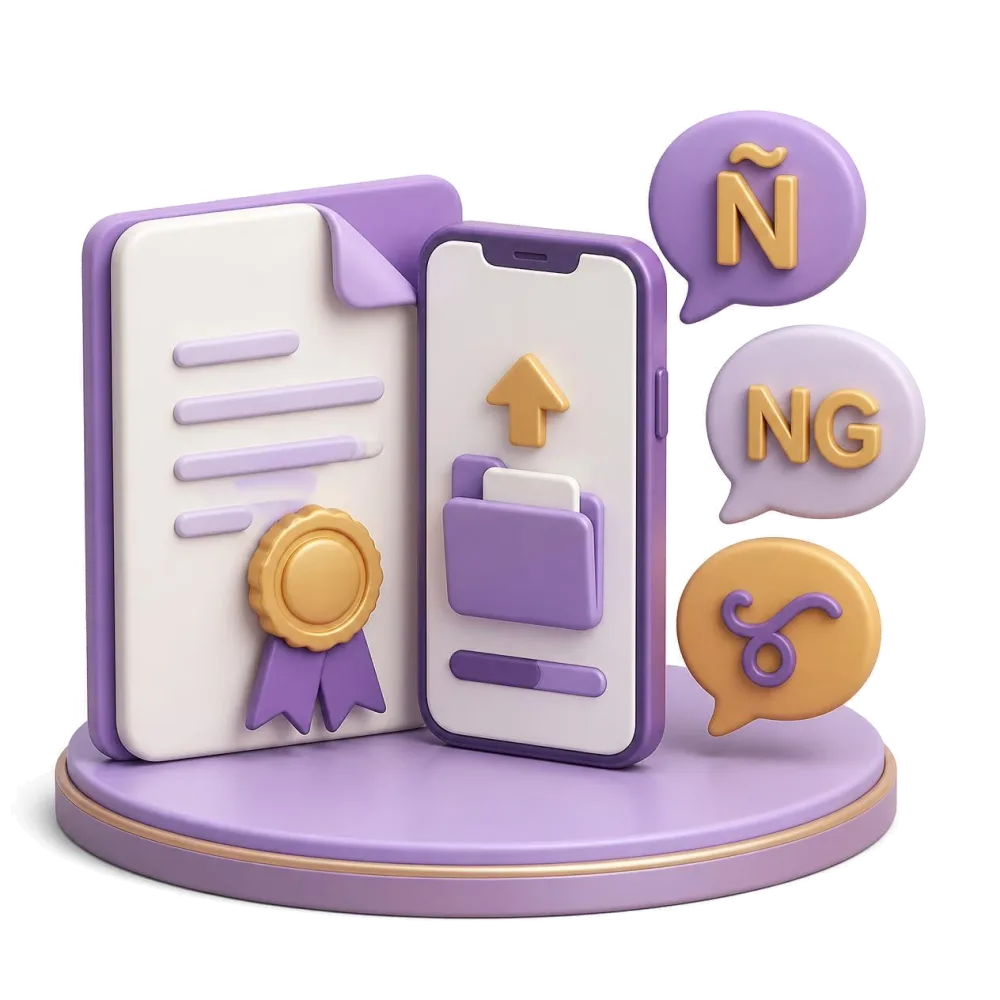
- Alphabet and spelling: the modern Filipino alphabet, adopted in 1987, has 28 letters, including Ñ and NG, while older texts use the 20 letters of the Abakada. Many surnames are Spanish, such as Santos or Reyes, and the spelling of your passport is the reference.
- Dates and numbers: Philippine documents often write dates as month, day and year, as in the United States, so 10/03/2026 is October 3, while forms such as the birth certificate have separate boxes for day, month and year. Decimals use a period and thousands a comma.
- Documents: the birth, marriage and death certificates issued by the Philippine Statistics Authority (PSA), the Certificate of No Marriage Record (CENOMAR), the barangay certificate and sworn statements (sinumpaang salaysay) are the most common. The translation reproduces every stamp, seal and note.

The history of the Tagalog language
Tagalog is an Austronesian language, of the same family as Cebuano, Ilocano, Malay and Indonesian, and its name comes from taga-ilog, people of the river. The Laguna Copperplate Inscription, dated 900 and found in 1989 near Laguna de Bay, is written mostly in Old Malay with Tagalog words, and before the Spanish arrived Tagalog was written in Baybayin, a script in which each sign is a syllable.
Spanish rule began in 1565 and lasted until 1898, and it left thousands of words in Tagalog and many Spanish surnames, spread by a catalog of surnames decreed in 1849. The Doctrina Christiana, printed in Manila in 1593, one of the first books printed in the Philippines, came out in Spanish and Tagalog, in Latin letters and in Baybayin. Under American rule, from 1898, English became the language of schools and government.
In 1937, President Manuel L. Quezon declared Tagalog the basis of the national language, which was named Pilipino in 1959 and Filipino in the Constitution of 1987. Today Tagalog has more than 20 million native speakers, and Filipino travels with the communities of the United States, Canada, the Gulf countries and Europe, whose birth, marriage and school records are still translated for immigration, work and family matters.

We also translate other languages
The Fastest Path to Your Translations
100% online
-

Send the document
-

Receive your quote
-

Human translation
-

First proofreading
-

Double proofreading
-

Fast delivery
-

Your satisfaction
We Translate All Types of Documents, Respecting the Original Format
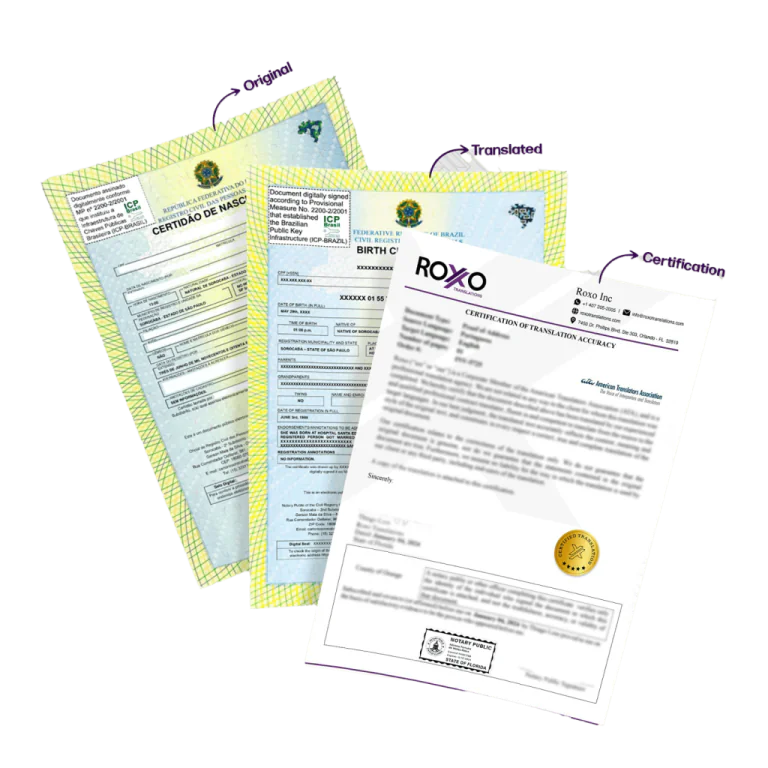
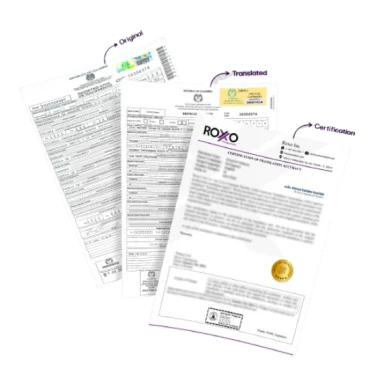
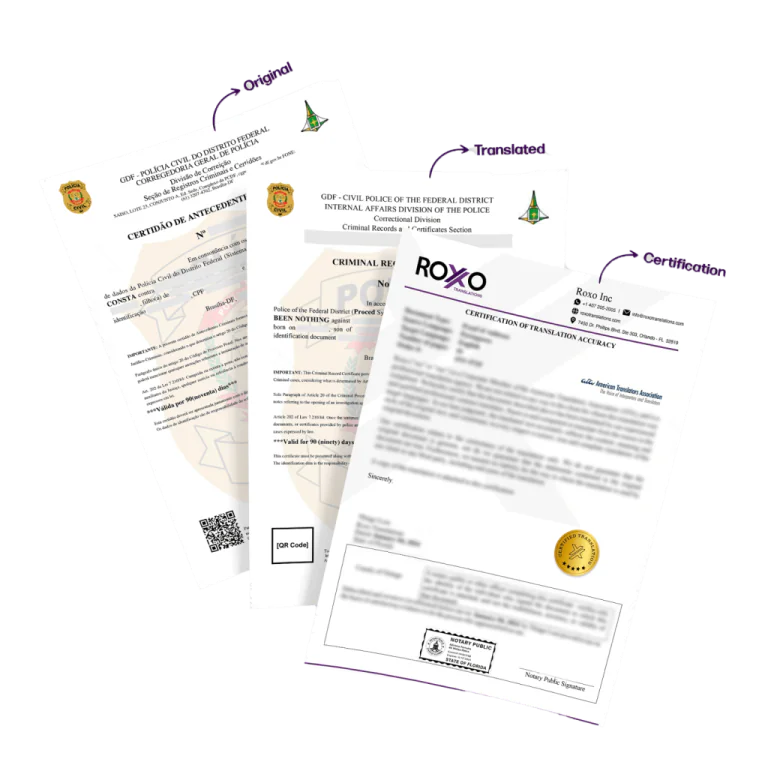
Documents we translate
Open 7 Days a Week to Serve You
Languages We Translate
Here are some of our most requested languages
 Arabic
 Chinese (Simplified)
 English (United States)
 French
 German
 Italian
 Japanese
 Korean
 Portuguese (Brazil)
 Russian
 Spanish
 Vietnamese
The 566 language pairs we translate today. Type a language to see which languages it pairs with.
Can't find your pair? Talk to us: we answer within one hour.
Certified Translation in the Main Cities of the USA
USCIS-accepted certified translations, with fast turnaround for clients across the United States.
Industry Solutions
Tailored Industry Solutions for Seamless Translations
Help Center
Turnaround, price, accepted documents and how to order: the most common questions are already answered in the Help Center, organized by topic.
Do you translate Tagalog and Filipino documents from the Philippines?
Yes. We translate documents in Tagalog and Filipino, such as PSA certificates, barangay certificates, sworn statements and letters, to and from English, Arabic, Italian and Russian. Filipino is the national standard built on Tagalog, and a Filipino name has a middle name that is the mother’s maiden surname, so we keep every name exactly as in the original and every date in the right order.
A name is spelled differently from my passport. Can you change it?
The translation reproduces names exactly as they appear in the original document. If you need another spelling, such as the one in your passport, tell us when you place your order, before we start. If we made a typo, we fix it at no cost.
What is a certified translation?
A certified translation is a complete translation signed by a qualified professional, with a statement attesting that it is accurate and complete. In the United States it is the format required by USCIS, courts, universities and most official institutions.
Which documents do you translate?
Birth, marriage and death certificates, divorce decrees, diplomas and transcripts, driver's licenses, passports and IDs, criminal records, bank and financial statements, medical and vaccination records, contracts, affidavits and court documents, among others. Send a photo and we confirm.
Is the translation done by people or by machine?
By people. Every document is translated by a professional linguist and goes through double human review for accuracy, grammar, formatting and consistency before delivery. The translator may use support tools, such as translation memory or machine translation, as an aid, but the translator who signs or certifies the work is always responsible for it.
Can you translate between two languages other than English, such as Italian to Portuguese?
Often yes, depending on the pair and the service. For certified translation we confirm translator availability. For sworn translation into Portuguese, some pairs require a two-step route through English. We tell you the option before quoting.
Check Out Our Blog!
Articles and content from the Roxo Translations team about translation, languages, and culture.

Can a family member translate your documents for USCIS?
Read More
Hukou translation: how to translate a Chinese household register for USCIS
Read More
Do you need a local certified translator? What actually matters for USCIS
Read More
Italian birth certificate translation: copia integrale, estratto or certificato?
Read More
Apostille in Sacramento: where California documents are apostilled
Read More
Apostille in Florida: who issues it, which copy is accepted and the fee
Read More
Divorce decree translation for use in the US: what is actually required
Read MoreOur Clients Trust and Recommend Us
100% Satisfied Customers